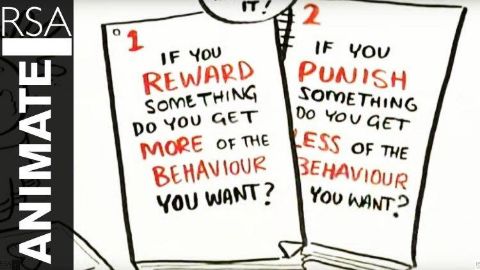
This lively RSA Animate, adapted from Dan Pink's talk at the RSA, illustrates the hidden truths behind what really motivates us at home and in the workplace.
Hope you're finding these documentaries fascinating and eye-opening. It's just me, working hard behind the scenes to bring you this enriching content.
Running and maintaining a website like this takes time and resources. That's why I'm reaching out to you. If you appreciate what I do and would like to support my efforts, would you consider "buying me a coffee"?
BTC: bc1q8ldskxh4x9qnddhcrgcun8rtvddeldm2a07r2v
ETH: 0x5CCAAA1afc5c5D814129d99277dDb5A979672116
With your donation through , you can show your appreciation and help me keep this project going. Every contribution, no matter how small, makes a significant impact. It goes directly towards covering server costs.
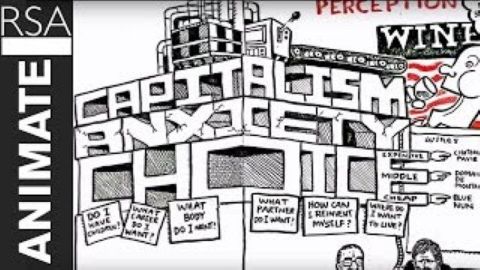
Professor Renata Salecl explores the paralysing anxiety and dissatisfaction surrounding limitless choice. Does the freedom to be the architects of our own lives actually hinder rather than help us? Does our preoccupation with choosing and consuming actually obstruct social change?
2011 • Economics
This lively RSA Animate, adapted from Dan Pink's talk at the RSA, illustrates the hidden truths behind what really motivates us at home and in the workplace.
2010 • Lifehack
Ever wondered why kids say they’re bored at school, or why they stop trying when the work gets harder? Educationalist Carol Dweck explains how the wrong kind of praise actually *harms* young people.
2015 • Lifehack
‘Economics is for everyone’, argues legendary economist Ha-Joon Chang in our latest mind-blowing RSA Animate. This is the video economists don’t want you to see! Chang explains why every single person can and SHOULD get their head around basic economics. He pulls back the curtain on the often mystifying language of derivatives and quantitative easing, and explains how easily economic myths and assumptions become gospel. Arm yourself with some facts, and get involved in discussions about the fundamentals that underpin our day-to-day lives.
2016 • Economics
In Japan, one couple gets divorced every 2 minutes. Often, the wife initiates the split. Many women say their partners don't understand their feelings, while many husbands seem unaware of the daily stress this can create. The latest research suggests that common marital misunderstandings are rooted in differences between the male and female brain. The problems couples experience today are the result of millions of years of evolution. This program uses findings from neuroscience to explore the issue, and suggests ways for couples to strengthen their bonds.
2017 • Lifehack
What motivates us to work? Contrary to conventional wisdom, it isn't just money. But it's not exactly joy either. It seems that most of us thrive by making constant progress and feeling a sense of purpose. Behavioral economist Dan Ariely presents two eye-opening experiments that reveal our unexpected and nuanced attitudes toward meaning in our work.
When faced with a big challenge where potential failure seems to lurk at every corner, you’ve probably heard the advice, “Be more confident!” But where does confidence come from, and how can you get more of it? Here are three easy tips to boost your confidence.
Join NOVA on a mathematical mystery tour—a provocative exploration of math's astonishing power across the centuries. We discover math's signature in the swirl of a nautilus shell, the whirlpool of a galaxy, and the spiral in the center of a sunflower. Math was essential to everything from the first wireless radio transmissions to the prediction and discovery of the Higgs boson and the successful landing of rovers on Mars. Astrophysicist and writer Mario Livio, along with a colorful cast of mathematicians, physicists, and engineers, follow math from Pythagoras to Einstein and beyond. It all leads to the ultimate riddle: Is math a human invention or the discovery of the language of the universe?
For love or money? Based on hundreds of interviews and his personal experience, Richard St. John suggests that passion, not money, is one of the key drivers of success.
The British Sleep Council says that 70 per cent of people in the UK do no get enough sleep. Gaby Roslin and Amir Khan present the first of two programmes in which they aim to put things right, applying the latest science to some of the worst sleepers. They include a sleep deprivation experiment, as well as help for an extreme snorer and a man who suffers from night terrors. A woman who has restless leg syndrome, and a man who has had chronic insomnia for 20 years. The sleep deprivation experiment continues, setting up a mini casino to test for risky behaviour, pain resistance and emotional control. Finally, as the subjects reach the final hours of the challenge, the experiment begins to take its toll as the participants' emotions go into overdrive, with one threatening to quit altogether.
2019 • Lifehack