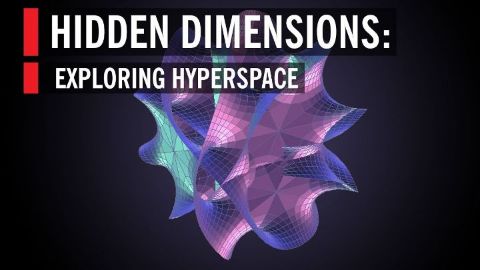
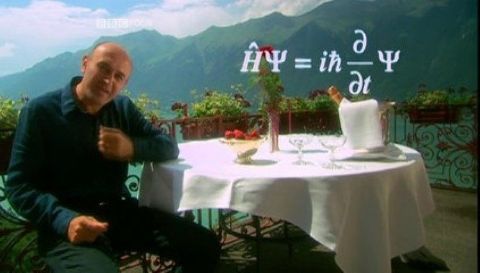
Extra dimensions of space — the idea that we are immersed in hyperspace — may be key to explaining the fundamental nature of the universe. Relativity introduced time as the fourth dimension, and Einstein’s subsequent work envisioned more dimensions still — but ultimately hit a dead end. Modern research has advanced the subject in ways he couldn’t have imagined. John Hockenberry joins Brian Greene, Lawrence Krauss, and other leading thinkers on a visual tour through wondrous spatial realms that may lie beyond the ones we experience.
Hope you're finding these documentaries fascinating and eye-opening. It's just me, working hard behind the scenes to bring you this enriching content.
Running and maintaining a website like this takes time and resources. That's why I'm reaching out to you. If you appreciate what I do and would like to support my efforts, would you consider "buying me a coffee"?
BTC: bc1q8ldskxh4x9qnddhcrgcun8rtvddeldm2a07r2v
ETH: 0x5CCAAA1afc5c5D814129d99277dDb5A979672116
With your donation through , you can show your appreciation and help me keep this project going. Every contribution, no matter how small, makes a significant impact. It goes directly towards covering server costs.
The multiverse hypothesis, suggesting that our universe is but one of perhaps infinitely many, speaks to the very nature of reality. Join physicist Brian Greene, cosmologists Alan Guth and Andrei Linde, and philosopher Nick Bostrom as they discuss and debate this controversial implication of forefront research and explore its potential for redefining the cosmic order. Moderated by Robert Krulwich and featuring an original musical interlude, inspired by parallel worlds, by DJ Spooky.
2015 • Astronomy
Ninety years after the historic double-slit experiment, the quantum revolution shows no sign of slowing. Join a vibrant conversation with renowned leaders in theoretical physics, quantum computation, and philosophical foundations, focused on how quantum physics continues to impact understanding on issues profound and practical, from the edge of black holes and the fibers of spacetime to teleportation and the future of computers.
What we touch. What we smell. What we feel. They’re all part of our reality. But what if life as we know it reflects only one side of the full story? Some of the world’s leading physicists think that this may be the case. They believe that our reality is a projection—sort of like a hologram—of laws and processes that exist on a thin surface surrounding us at the edge of the universe.
2014 • Physics
From a bee’s hexagonal honeycomb to the elliptical paths of planets, symmetry has long been recognized as a vital quality of nature. Einstein saw symmetry hidden in the fabric of space and time. The brilliant Emmy Noether proved that symmetry is the mathematical flower of deeply rooted physical law. And today’s theorists are pursuing an even more exotic symmetry that, mathematically speaking, could be nature’s final fundamental symmetry: supersymmetry.
2016 • Math
A new generation of technology is revolutionizing neuroscience, allowing a closer study of the brain than had ever seemed possible. The techniques are hybrids of optics, genetics, and synthetic biology with the ability to manipulate brain activity, often in real time. Through direct stimulation of neural connections, some of these techniques hold the promise for the treatment of diseases like depression or schizophrenia.
2019 • Brain
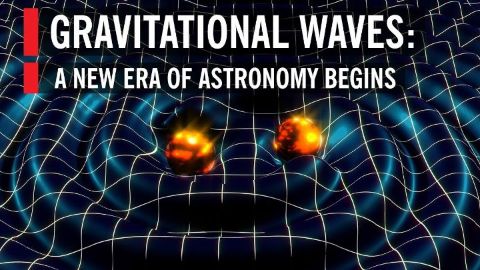
On September 14th, 2015, a ripple in the fabric of space, created by the violent collision of two distant black holes over a billion years ago, washed across the Earth. As it did, two laser-based detectors, 50 years in the making – one in Louisiana and the other in Washington State – momentarily twitched, confirming a century-old prediction by Albert Einstein and marking the opening of a new era in astronomy. Join some of the very scientists responsible for this most anticipated discovery of our age and see how gravitational waves will be used to explore the universe like never before.
2016 • Astronomy
Extra dimensions of space — the idea that we are immersed in hyperspace — may be key to explaining the fundamental nature of the universe. Relativity introduced time as the fourth dimension, and Einstein’s subsequent work envisioned more dimensions still — but ultimately hit a dead end. Modern research has advanced the subject in ways he couldn’t have imagined. John Hockenberry joins Brian Greene, Lawrence Krauss, and other leading thinkers on a visual tour through wondrous spatial realms that may lie beyond the ones we experience.
2015 • Physics
What happened to all of the universe's antimatter? Can a particle be its own anti-particle? And how do you build an experiment to find out? In this program, particle physicists reveal their hunt for a neutrino event so rare, it happens to a single atom at most once every 10,000,000,000,000,000,000,000,000 years: far longer than the current age of the universe. If they find it, it could explain no less than the existence of our matter-filled universe.
2019 • Physics
Scientists are now finally discovering what thinkers, musicians, or even any of us with a Spotify account and a set of headphones could have told you on instinct: music lights up multiple corners of the brain, strengthening our neural networks, firing up memory and emotion, and showing us what it means to be human. In fact, music is as essential to being human as language and may even predate it. Can music also repair broken networks, restore memory, and strengthen the brain?
2019 • Music
When no one is looking, a particle has near limitless potential: it can be nearly anywhere. But measure it, and the particle snaps to one position. How do subatomic objects shed their quantum weirdness? Experts in the field of physics, including David Z. Albert, Sean Carroll, Sheldon Goldstein, Ruediger Schack, and moderator Brian Greene, discuss the history of quantum mechanics, current theories in the field, and possibilities for the future.
2014 • Physics
Stuff happens. The weather forecast says it’s sunny, but you just got drenched. You got a flu shot—but you’re sick in bed with the flu. Your best friend from Boston met your other best friend from San Francisco. Coincidentally. What are the odds? Risk, probability, chance, coincidence—they play a significant role in the way we make decisions about health, education, relationships, and money. But where does this data come from and what does it really mean?
2015 • Math
You exist. You shouldn’t. Stars and galaxies and planets exist. They shouldn’t. The nascent universe contained equal parts matter and antimatter that should have instantly obliterated each other, turning the Big Bang into the Big Fizzle. And yet, here we are: flesh, blood, stars, moons, sky. Why? Come join us as we dive deep down the rabbit hole of solving the mystery of the missing antimatter.
2018 • Physics
The quantum mechanics revolution has revolutionized modern technology. Renowned physicist Brian Greene takes us on a journey through the modern electronic age, from transistors to fiber optics, all made possible through quantum mechanics.
S1E3 • Exploring Quantum History with Brian Greene • 2016 • Physics
This documentary presents the story of Nikola Tesla, the great scientist, visionary, and inventor who gave the world alternating current electricity, as well as being the father of radio. The film tells the story of this man's astonishing genius, his visions and inventions. Tesla's own scientific and autobiographical writings, as well as archival photographs and re-enactments are used to tell the story. A native of Austro-Hungary, Tesla came to America in 1884. Working first with Edison, the two inventors fell out over Edison's insistence on using direct current. Tesla took his alternating current vision to Westinghouse. His New York address was renowned for the bolts of lightning emanating from it, as Tesla worked to unlock the secrets of energy and electricity. His quest took him to Colorado. The film follows Tesla's exploits and eccentricities, which made him a darling of the press. Included is the well-known and touching story of his devotion to a certain white pigeon. Largely forgotten today in spite of the great debt the modern world owes him, the film pays tribute to this overlooked genius.
2007 • Physics
It's called the speed limit of the universe. Einstein blew all of our minds when he worked out the Theory of Relativity, and showed that space and time were malleable substances. He also theorized that we as humans can never travel faster than the speed of light, which leaves the stars and other galaxies almost impossibly out of our reach. But the dreams of Star Wars and Star Trek are not dead. In fact, there could be ways to travel faster than the speed of light - and some of them are already being tested in labs around the world.
S2E08 • Through the Wormhole • Physics
Planet Earth grows to outlandish proportions that causes lying down to become the new standing up, the sun gets big ideas giving us a 20,000-year winter before blowing up in the biggest explosion since the big bang, we meet a dog the size of a dinosaur and Joe himself turns into a 49ft giant.
S1E1 • Size Matters • 2019 • Physics