Scientists are now finally discovering what thinkers, musicians, or even any of us with a Spotify account and a set of headphones could have told you on instinct: music lights up multiple corners of the brain, strengthening our neural networks, firing up memory and emotion, and showing us what it means to be human. In fact, music is as essential to being human as language and may even predate it. Can music also repair broken networks, restore memory, and strengthen the brain?
Hope you're finding these documentaries fascinating and eye-opening. It's just me, working hard behind the scenes to bring you this enriching content.
Running and maintaining a website like this takes time and resources. That's why I'm reaching out to you. If you appreciate what I do and would like to support my efforts, would you consider "buying me a coffee"?
BTC: bc1q8ldskxh4x9qnddhcrgcun8rtvddeldm2a07r2v
ETH: 0x5CCAAA1afc5c5D814129d99277dDb5A979672116
With your donation through , you can show your appreciation and help me keep this project going. Every contribution, no matter how small, makes a significant impact. It goes directly towards covering server costs.
The multiverse hypothesis, suggesting that our universe is but one of perhaps infinitely many, speaks to the very nature of reality. Join physicist Brian Greene, cosmologists Alan Guth and Andrei Linde, and philosopher Nick Bostrom as they discuss and debate this controversial implication of forefront research and explore its potential for redefining the cosmic order. Moderated by Robert Krulwich and featuring an original musical interlude, inspired by parallel worlds, by DJ Spooky.
2015 • Astronomy
Ninety years after the historic double-slit experiment, the quantum revolution shows no sign of slowing. Join a vibrant conversation with renowned leaders in theoretical physics, quantum computation, and philosophical foundations, focused on how quantum physics continues to impact understanding on issues profound and practical, from the edge of black holes and the fibers of spacetime to teleportation and the future of computers.
What we touch. What we smell. What we feel. They’re all part of our reality. But what if life as we know it reflects only one side of the full story? Some of the world’s leading physicists think that this may be the case. They believe that our reality is a projection—sort of like a hologram—of laws and processes that exist on a thin surface surrounding us at the edge of the universe.
2014 • Physics
From a bee’s hexagonal honeycomb to the elliptical paths of planets, symmetry has long been recognized as a vital quality of nature. Einstein saw symmetry hidden in the fabric of space and time. The brilliant Emmy Noether proved that symmetry is the mathematical flower of deeply rooted physical law. And today’s theorists are pursuing an even more exotic symmetry that, mathematically speaking, could be nature’s final fundamental symmetry: supersymmetry.
2016 • Math
A new generation of technology is revolutionizing neuroscience, allowing a closer study of the brain than had ever seemed possible. The techniques are hybrids of optics, genetics, and synthetic biology with the ability to manipulate brain activity, often in real time. Through direct stimulation of neural connections, some of these techniques hold the promise for the treatment of diseases like depression or schizophrenia.
2019 • Brain
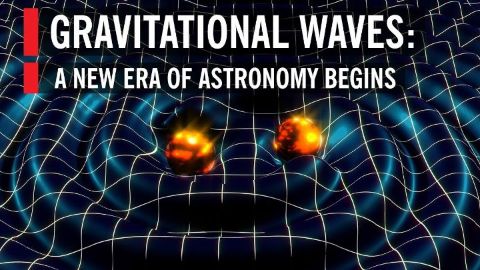
On September 14th, 2015, a ripple in the fabric of space, created by the violent collision of two distant black holes over a billion years ago, washed across the Earth. As it did, two laser-based detectors, 50 years in the making – one in Louisiana and the other in Washington State – momentarily twitched, confirming a century-old prediction by Albert Einstein and marking the opening of a new era in astronomy. Join some of the very scientists responsible for this most anticipated discovery of our age and see how gravitational waves will be used to explore the universe like never before.
2016 • Astronomy
Extra dimensions of space — the idea that we are immersed in hyperspace — may be key to explaining the fundamental nature of the universe. Relativity introduced time as the fourth dimension, and Einstein’s subsequent work envisioned more dimensions still — but ultimately hit a dead end. Modern research has advanced the subject in ways he couldn’t have imagined. John Hockenberry joins Brian Greene, Lawrence Krauss, and other leading thinkers on a visual tour through wondrous spatial realms that may lie beyond the ones we experience.
2015 • Physics
What happened to all of the universe's antimatter? Can a particle be its own anti-particle? And how do you build an experiment to find out? In this program, particle physicists reveal their hunt for a neutrino event so rare, it happens to a single atom at most once every 10,000,000,000,000,000,000,000,000 years: far longer than the current age of the universe. If they find it, it could explain no less than the existence of our matter-filled universe.
2019 • Physics
Scientists are now finally discovering what thinkers, musicians, or even any of us with a Spotify account and a set of headphones could have told you on instinct: music lights up multiple corners of the brain, strengthening our neural networks, firing up memory and emotion, and showing us what it means to be human. In fact, music is as essential to being human as language and may even predate it. Can music also repair broken networks, restore memory, and strengthen the brain?
2019 • Music
When no one is looking, a particle has near limitless potential: it can be nearly anywhere. But measure it, and the particle snaps to one position. How do subatomic objects shed their quantum weirdness? Experts in the field of physics, including David Z. Albert, Sean Carroll, Sheldon Goldstein, Ruediger Schack, and moderator Brian Greene, discuss the history of quantum mechanics, current theories in the field, and possibilities for the future.
2014 • Physics
Stuff happens. The weather forecast says it’s sunny, but you just got drenched. You got a flu shot—but you’re sick in bed with the flu. Your best friend from Boston met your other best friend from San Francisco. Coincidentally. What are the odds? Risk, probability, chance, coincidence—they play a significant role in the way we make decisions about health, education, relationships, and money. But where does this data come from and what does it really mean?
2015 • Math
You exist. You shouldn’t. Stars and galaxies and planets exist. They shouldn’t. The nascent universe contained equal parts matter and antimatter that should have instantly obliterated each other, turning the Big Bang into the Big Fizzle. And yet, here we are: flesh, blood, stars, moons, sky. Why? Come join us as we dive deep down the rabbit hole of solving the mystery of the missing antimatter.
2018 • Physics
We don't know much about the human brain on music. Do people instinctively know the sound patterns of the pentatonic scale? Is there a base level of musical knowledge in all of us, just waiting to be tapped? Or is the pentatonic scale simply so common in Western music that it has become ingrained in all of our minds? Improvisational genius Bobby McFerrin uses audience participation to demonstrate the power of the pentatonic scale - or at least the audience's familiarity with it.
2011 • Music
How many times does the chorus repeat in your favorite song? How many times have you listened to that chorus? Repetition in music isn’t just a feature of Western pop songs, either; it’s a global phenomenon. Why? Elizabeth Hellmuth Margulis walks us through the basic principles of the ‘exposure effect,’ detailing how repetition invites us into music as active participants, rather than passive listeners.
Behind-the-scenes archive documentary following Queen's Freddie Mercury, Brian May, Roger Taylor and John Deacon as they record their sixth album News of the World and embark on a groundbreaking tour of North America. By 1977, Queen had become a major headlining act in the UK, releasing chart-topping albums and singles as well as playing sell-out concerts in all the country's major venues. However, they were facing an increasingly hostile music press, who had a new favourite in punk and had turned against the elaborate, multi-layered recording techniques that had become the hallmark of the band's previous albums. But an unfazed Queen had their sights set on greater things. As the band announced plans to record their next album, the expectation was it would be another production extravaganza, but Freddie, Brian, Roger and John already had other ideas. News of the World showcased them at their most raw, simple and best, returning to their roots as a live act. With a self-imposed limit on studio time and produced entirely on their own for the first time, this stripped-back album took the fans and press by surprise and demonstrated Queen's ability to transcend fashions. It was to prove a seminal moment in the band's history. At the time, BBC music presenter Bob Harris was given exclusive and extensive access to the band to cover this period. Conducting insightful interviews with all four band members as well as filming them at work in the studio as they were planning and rehearsing their forthcoming North American tour, and then following them as they performed across the US, Bob captured a band attempting to replicate their huge domestic success on the global stage. Curiously, the documentary he set out to make was never completed, and the footage lay unused in the archive until now. To mark the 40th anniversary of the release of the News of the World album, the footage has now been carefully restored and revisited to compile this hour-long portrait of a group setting out to take the next step on their remarkable journey to becoming one of the biggest bands on the planet. Armed with an array of new songs, including the monster hits We Will Rock You and We Are the Champions, Queen dazzled the American audience and laid the foundations of a relationship that endures to this very day. Coming full circle, this film is bookended by footage shot in the summer of 2017 as Brian May and Roger Taylor took Queen back to the US with Adam Lambert as lead singer. Revisiting many of the cities they had performed in 40 years previously and including many of the songs from that 1977 album, they prove that despite the tragic loss of Freddie Mercury over 25 years ago, Queen can still rock the world.
2017 • Music
DJ and broadcaster Rita Ray travels to Nigeria, home of some of the most influential African music of the last 60 years. The country's extraordinary polyrhythms have powered highlife, funk and Afrobeat for decades, and can still be heard in modern pop music. Travelling to Lagos and beyond, Rita traces the importance of rhythm in Nigeria's music and discovers the many different musical styles it has created, from Yoruba juju music, to acoustic singer-songwriters and world-class pop.
1 • Africa: A Journey into Music • 2018 • Music
Kurt Cobain, legendary lead singer, guitarist and songwriter of Nirvana, “the flagship band of Generation X,” remains an object of reverence and fascination for music fans around the world. His story is told for the first time in KURT COBAIN: MONTAGE OF HECK
2015 • Music
Tom Service plunges into the life and times of Mozart to try and rediscover the greatness and humanity of the living man in his moment.