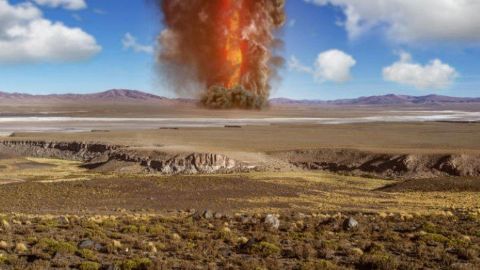
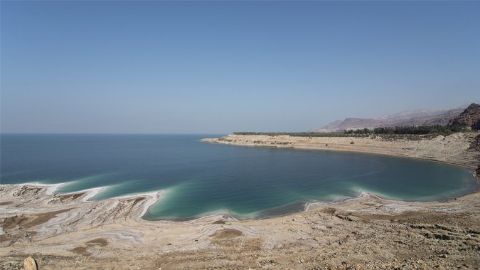
From the global perspective of space, this 2-hour special reveals the breathtaking extent of our influence, revealing how we’ve transformed our planet and produced an interconnected world of extraordinary complexity. A journey through 12,000 years, Humanity from Space shows how seemingly small flashes of innovation have changed the course of civilization; innovations that touch all of us today in ways unimaginable to our ancestors. And we’ll gaze into the future at the new challenges we’ll face in order to survive as our global population soars because of our success. In every case we’ll look at our progression in a unique and surprising way, revealing unforgettable facts and "who knew?" connections. To visualize these stories cutting-edge technology is used to turn raw data into authentic moving images, building on expertise from a previous (and highly-praised) project; "Earth From Space." Using this technique, we can map humanity’s behavior in stunning, never seen before detail, revealing how our civilization grew, how it works today and what the future might hold.
Hope you're finding these documentaries fascinating and eye-opening. It's just me, working hard behind the scenes to bring you this enriching content.
Running and maintaining a website like this takes time and resources. That's why I'm reaching out to you. If you appreciate what I do and would like to support my efforts, would you consider "buying me a coffee"?
BTC: bc1q8ldskxh4x9qnddhcrgcun8rtvddeldm2a07r2v
ETH: 0x5CCAAA1afc5c5D814129d99277dDb5A979672116
With your donation through , you can show your appreciation and help me keep this project going. Every contribution, no matter how small, makes a significant impact. It goes directly towards covering server costs.
An average guy Jeb Berrier, makes a resolution to stop using plastic bags at the grocery store. Little does he know that this simple decision will change his life completely. He comes to the conclusion that our consumptive use of plastic has finally caught up to us, and looks at what we can do about it.
2010 • Environment
Discover how New York City – overwhelmed in 2012 by Superstorm Sandy – has learned from that disaster, and must defend itself against rising seas and the next big storm. With 520 miles of shoreline and no coastal protection, engineers and urban planners are tackling the problem with urgency and creative engineering.
S1E1 • Sinking Cities • 2018 • Environment
One man has seen more of the natural world than any other. This unique feature documentary is his witness statement. Having spent decades traveling the globe and producing some of the most memorable documentaries of all time, few people know the natural world quite like David Attenborough. That’s why he’s so concerned about the issue of climate change, which will threaten humanity’s very survival unless urgent action is taken to halt the damage it has already caused. Attenborough’s latest offering, A Life On Our Planet, is a reflective piece, looking back on his 94 years on Earth and sending a desperate appeal for help in securing its future.
2020 • Environment
All over the world, scientists are discovering traces of ancient floods on a scale that dwarfs even the most severe flood disasters of recent times. What triggered these cataclysmic floods, and could they strike again? In the Channeled Scablands of Washington State, the level prairie gives way to bizarre, gargantuan rock formations: house-sized boulders seemingly dropped from the sky, a cliff carved by a waterfall twice the height of Niagara, and potholes large enough to swallow cars. Like forensic detectives at a crime scene, geologists study these strange features and reconstruct catastrophic Ice Age floods more powerful than all the world’s top ten rivers combined. NOVA follows their efforts to uncover the geologic fingerprints of other colossal megafloods in Iceland and, improbably, on the seabed of the English Channel. There, another deluge smashed through a land bridge connecting Britain and France hundreds of thousands of years ago and turned Britain into an island for the first time. These great disasters ripped through terrain and transformed continents in a matter of hours—and similar forces reawakened by climate change are posing an active threat to mountain communities throughout the world today.
NOVA PBS • 2017 • Environment
This episode focuses on the Asia-Pacific side of The Pacific Rim of Fire, which stands as a living testament to the beauty and danger that powerful geologic forces can deliver. The Pacific Rim is home to half of the world's active volcanoes and ninety percent of the world's earthquakes, yet nearly 800 million people continue to live within its violent edge. Our journey begins in New Zealand, a land of volcanoes and earthquakes, where we find a 500-kilometre long slip-strike fault deep under the Pacific Ocean. Geologist Hamish Campbell will take us to the crater of White Island, the country’s most active volcano. Then we'll visit the country's southern island with John Youngson, to find out how New Zealand’s longest fault-line contributes to the gold industry. Finally in Japan, viewers will hike up to Mount Fuji – the iconic peak where science and legend converge, getting up-close and personal with a fault-line witnessing firsthand what it’s like to discover new ways of monitoring, and hopefully one day predicting, seismic activity onboard the world’s most advanced drilling vessels.
S50E07 • The Nature of Things • 2010 • Environment
As climate change begins to feel like an impossible challenge, this documentary tells the story of the first man-made threat to the planet's environment - the hole in the ozone layer - and how the world managed to fix it. The scientists and politicians at the heart of the story reveal how they spotted the giant hole in the stratosphere and, against all odds, persuaded Ronald Reagan and Margaret Thatcher - two of the most unlikely eco-warriors in history - to take action.
2018 • Environment