Marc-André Leclerc climbs alone, far from the limelight. The free-spirited 23-year-old makes some of the boldest solo ascents in history. With no cameras and no margin for error, Leclerc's approach is the essence of solo adventure.
Hope you're finding these documentaries fascinating and eye-opening. It's just me, working hard behind the scenes to bring you this enriching content.
Running and maintaining a website like this takes time and resources. That's why I'm reaching out to you. If you appreciate what I do and would like to support my efforts, would you consider "buying me a coffee"?
BTC: bc1q8ldskxh4x9qnddhcrgcun8rtvddeldm2a07r2v
ETH: 0x5CCAAA1afc5c5D814129d99277dDb5A979672116
With your donation through , you can show your appreciation and help me keep this project going. Every contribution, no matter how small, makes a significant impact. It goes directly towards covering server costs.
After 9/11, Osama goes into hiding. But US Navy Seals are on his tail. In 1997, bin Laden's al-Qaida expanded its operations in Afghanistan. With the United States as his target, he occasionally gives interviews to US networks from his base in the mountains to take his threats straight into the enemy's living room. In 1998, bin Laden followed with his infamous fatwa, in which he declared the killing of civilians and soldiers of the United States and its allies everywhere as the duty of every Muslim. Just months later, the US embassies in Tanzania and Kenya are bombed, followed by a missile attack on Bin Laden's training camp and placing him on the FBI's 10 Most Wanted List. That doesn't deter him, however: in 2000, the secret services already suspected that "something was up" when al-Qaeda activists attacked a US warship and killed 17 people. In 2001, the first plans for an attack on the twin towers were already five years old. One of bin Laden's closest associates, Abu Hafs, disagrees with the strategy and leaves al-Qaeda before the operation goes ahead. On September 11, when the only TV station authorized by the Taliban broadcast the attack, a revolt broke out among the mujahideen. When George W. Bush declared the war on terror, bin Laden withdrew to the Tora Bora mountains. He never stays in the same place and always stays out of reach of American forces. In 2005, he and his family moved into a large house in Abbottabad, Pakistan. There he lived unnoticed by the public until he was shot dead during an intelligence operation by US Navy SEALs in 2011.
S1E3 • Bin Laden: The Road to 9.11 • 2021 • People
The life and work of M.C. Escher is presented primarily through his own words in the form of his writings being read against a backdrop of images associated to him, including archival footage of himself and images of his drawings. Many further details are provided by surviving family members. Escher himself considered what he did being caught between the worlds of art and mathematics - he not very good at either - his drawings always having an element of geometry. He made a conscious decision to work in monochromatic black and white realizing that he would be missing being able to convey ideas that are inherent with color. The evolution to two of his later periods is discussed, namely his series of drawings of the human eye, and what would become his ultimate fascination, that of the concept of infinity, whether it be real, as in the circle or the study of a man viewing a picture of himself viewing a picture of himself and so on, or perceived through illusions, such as his never-ending staircase. The documentary is buttressed by commentary from fan, musician Graham Nash who believes his brilliance has not yet been fully appreciated. Further Information
2021 • People
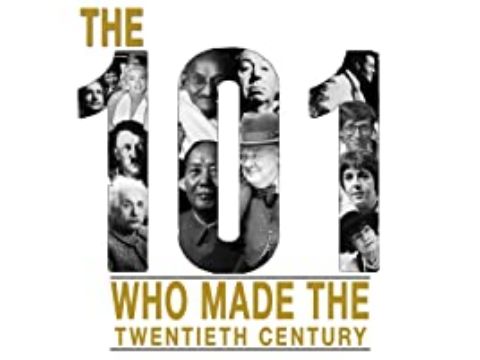
If this episode teaches us anything it’s that revolutionaries come in many different forms. All thirteen of our subjects have been pioneers and leaders in their fields and have changed everything, from the way we watch films to how we connect and work. For some the word revolutionary might only be a title but for others, such as Castro and Ghandi, it is far more real. This episode of heroes and villains features some of the most famous and infamous faces of the twentieth century.
S1E5 • The 101 People who Made the 20th Century • 2016 • People
More than five centuries ago, Michelangelo Buonarroti was the darling of the Catholic Church. Throughout his masterful career, the Papacy commissioned him to create many of its most important pieces, including the frescoes of the Sistine Chapel. He spent his life glorifying the Church, etching Catholic ideals into masterpieces that defined religion for the masses. Yet when he died, his body was secretly shepherded off to Florence, and the Church was denied the opportunity to honor him with a grand funeral in Rome. Historians have long wondered about the mysterious circumstances surrounding his death, but now, five hundred years after his death, new finds are revealing a darker side to the master artisan. While restoring Michelangelo's sculptures in the tomb of Julius II, art historian Antonio Forcellino noticed some strange inconsistencies in the famous statue: "The Moses." Forcellino believes he has pieced together evidence of a deep rift between the Church and the esteemed artist. The cause: Michelangelo's belief in Protestant ideals. The imperfections in the statue started him on a careful scientific and historical investigation that exposed remarkable evidence of Michelangelo's involvement with a clandestine fellowship trying to put an end to the decadence and corruption of the Clergy and reform the Church from within. The group's radical ideas and accusations of corruption were considered heretical and punishable by death. Michelangelo's involvement put him at dangerous odds with powerful officials who held his livelihood - and life - in their hands. "Michelangelo Revealed" takes us back over 500 years to the dangerous political climate of papal Rome, vividly portrayed through dramatic reconstruction. We are thrown into the heart of a fierce battle for religious control between the cardinals, and the resulting injustices of the Inquisition, shedding new light on the angst surrounding Michelangelo's "Last Judgement" in the Sistine Chapel and his previously shrouded connections to a subversive religious group and persecuted religious beliefs. "Secrets of the Dead: Michelangelo Revealed" deconstructs the puzzling discrepancies between the sculptures Michelangelo created and the way he described them, revealing an intricate effort to carve his own beliefs into stone, while protecting himself from the wrath of a powerful Cardinal who viewed him as a heretic. MICHELANGELO REVEALED paints a stunning new picture of brave religious expression, personal vendettas, careful cover-ups and a most gifted artist desperately trying to reconcile his loyalty to the church with his own personal belief about the road to salvation.
Secrets of the Dead • 2008 • People
From his wardrobe to his secret tunnels to his private pimps, discover the true story of Charles II.
S1E5 • Private Lives of the Monarchs • 2017 • People