The entire field of mathematics summarised in a single map! This shows how pure mathematics and applied mathematics relate to each other and all of the sub-topics they are made from.
Hope you're finding these documentaries fascinating and eye-opening. It's just me, working hard behind the scenes to bring you this enriching content.
Running and maintaining a website like this takes time and resources. That's why I'm reaching out to you. If you appreciate what I do and would like to support my efforts, would you consider "buying me a coffee"?
BTC: bc1q8ldskxh4x9qnddhcrgcun8rtvddeldm2a07r2v
ETH: 0x5CCAAA1afc5c5D814129d99277dDb5A979672116
With your donation through , you can show your appreciation and help me keep this project going. Every contribution, no matter how small, makes a significant impact. It goes directly towards covering server costs.
From a bee’s hexagonal honeycomb to the elliptical paths of planets, symmetry has long been recognized as a vital quality of nature. Einstein saw symmetry hidden in the fabric of space and time. The brilliant Emmy Noether proved that symmetry is the mathematical flower of deeply rooted physical law. And today’s theorists are pursuing an even more exotic symmetry that, mathematically speaking, could be nature’s final fundamental symmetry: supersymmetry.
World Science Festival • 2016 • Math
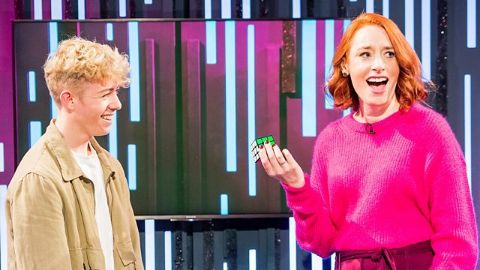
Dr Hannah Fry reveals how data-gobbling algorithms have taken over our lives and now control almost everything we do, without us being aware of it. Pitching the UK speed-cubing champion against a machine in the opening seconds of the lecture, Hannah sets the pace for a rapid voyage through this superhuman world. Hannah teams up with famed YouTuber Tom Scott to create a viral video and decipher YouTube's secret algorithm, comes face to face with four-legged guests to put animal image recognition machines to the test, and reveals how the NHS is matching organ donors in chains across the country to save hundreds of lives. But the breakthroughs are not restricted to the real world. Bafta award-winning special guests reveal the secrets of CGI in films such as The Avengers and Lord of the Rings, and supersized laser illusions bring the Royal Institution to life. An unexpected feathery guest opens our eyes to a new type of coding, where computers can be trained like animals using tasty rewards, with maths comedian Matt Parker and computing expert Dr Anne-Marie Imafidon bringing the topic to life. Finally, Hannah reveals how we've all been training up Google's AI in this way for years without realising it, and discovers how Google Health is using big data to give doctors a helping hand. The power of algorithms is undeniable. Hannah ultimately discovers how we can bend the world to our will and make anything possible, with a bit of mathematical thinking.
S1E2 • Royal Institution Christmas Lectures: Secrets and Lies - The Hidden Power of Maths • 2019 • Math
Professor David Spiegelhalter tries to pin down what chance is and how it works in the real world. A blend of wit and wisdom, animation, graphics and gleeful nerdery is applied to the joys of chance and the mysteries of probability, the vital branch of mathematics that gives us a handle on what might happen in the future. How can you maximise your chances of living till you're 100? Why do many of us experience so many spooky coincidences? Should I take an umbrella? These are just some of the everyday questions the film tackles as it moves between Cambridge, Las Vegas, San Francisco and Reading. Spiegelhalter discovers One Million Random Digits, a book full of hidden patterns and shapes, introduces us to the unit called the micromort (a one-in-a-million chance of dying), and uses the latest infographics to demonstrate how life expectancy has increased in his lifetime and how it is affected by our lifestyle choices - drinking, obesity, smoking and exercise.
2012 • Math
One hundred green-eyed logicians have been imprisoned on an island by a mad dictator. Their only hope for freedom lies in the answer to one famously difficult logic puzzle. Can you solve it? Alex Gendler walks us through this green-eyed riddle.
Imagine a game of dice: if the biggest number rolled is one, two, three, or four, player 1 wins. If the biggest number rolled is five or six, player 2 wins. Who has the best probability of winning the game? Leonardo Barichello explains how probability holds the answer to this seemingly counterintuitive puzzle.
Documentary that reveals the secret story behind one of the greatest intellectual feats of World War II, a feat that gave birth to the digital age. In 1943 a 24-year-old maths student and a GPO engineer combined to hack into Hitler's personal super code machine - not Enigma but an even tougher system, which he called his 'secrets writer'. Their break turned the Battle of Kursk, powered the D-day landings and orchestrated the end of the conflict in Europe. But it was also to be used during the Cold War - which meant both men's achievements were hushed up and never officially recognised.
2011 • Math