Ritchie Blackmore is beyond doubt one of the all-time great guitar players. The Ritchie Blackmore Story traces the long and winding road of the guitar legend — from his early days as a session player (with legendary producer Joe Meek) and his early '60s combo the Outlaws up through his years guiding one of hard rock's finest bands, Deep Purple, the formation of Rainbow and into his recent work with Blackmore's Night. Ritchie has proven to be a master of the guitar across a multitude of styles. The 'man in black' helped invent neo-classical heavy metal with his medieval-oriented guitar solos. He gave the world perhaps the most played guitar riff ever with the opening notes to "Smoke on the Water." For the first time his story is told in this extraordinary rockumentary. "The Ritchie Blackmore Story" tells the career through some of it's historical performance and extensive specially recorded new interviews with Ritchie himself and many of his colleagues and admirers including: Brian May, Glenn Hughes, Lars Ulrich, Steve Lukather, Joe Satriani, the late Jon Lord, David Coverdale, Gene Simmons, Joe Lynn Turner, Steve Vai, Graham Bonnet and Ian Anderson. This is the definitive story of a true guitar legend.
Hope you're finding these documentaries fascinating and eye-opening. It's just me, working hard behind the scenes to bring you this enriching content.
Running and maintaining a website like this takes time and resources. That's why I'm reaching out to you. If you appreciate what I do and would like to support my efforts, would you consider "buying me a coffee"?
BTC: bc1q8ldskxh4x9qnddhcrgcun8rtvddeldm2a07r2v
ETH: 0x5CCAAA1afc5c5D814129d99277dDb5A979672116
With your donation through , you can show your appreciation and help me keep this project going. Every contribution, no matter how small, makes a significant impact. It goes directly towards covering server costs.

From the waltz to voguing, dance crazes have connected people throughout history. But when a dance catches on, who gets the credit - and compensation?
In episode two, Whole Lotta Shakin', the rock 'n' roll story continues with the boom in the sound across America and its move into mainstream culture thanks to seminal TV appearances from Elvis, who made his small-screen debut with a rendition of Heartbreak Hotel before his notoriously sexualised performance of Hound Dog that caused shockwaves across conservative America. The programme explores the media's failed attempts to suppress the genre before wholesome Buddy Holly calmed the waters, converting geeky looks into chart success, before scandal again in 1958 with Elvis's conscription to the army and Jerry Lee Lewis's career suicide when he married his 13-year-old cousin.
S1E2 • Rock and Roll America • 2015 • Music
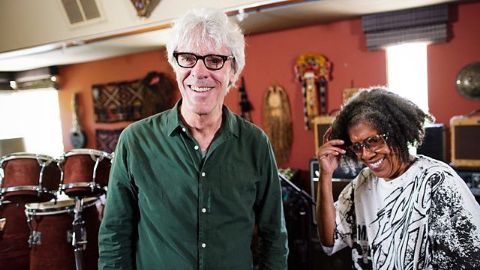
Stewart Copeland explores the drums as the founding instrument of popular modern music. Beats that travelled from Africa via New Orleans and across the world are the consistent force behind musical evolution. Stewart plays with some of the most inspiring drummers of the last 50 years, including John Densmore of The Doors, Chad Smith of The Red Hot Chilli Peppers, Prince’s musical director Sheila E, New Order’s Stephen Morris and Foo Fighters’ Taylor Hawkins. He goes dancing in New Orleans, builds his own bass drum pedal and checks out hot new bands on Santa Monica beach.
S1E1 • Guitar, Drum and Bass • 2019 • Music
Suzy Klein explores the use, abuse and manipulation of music in the Second World War - from swinging jazz to film soundtracks and from ballads to ballets. The war, she demonstrates, wasn't just a military fight but an ideological battle where both sides used music as a weapon to secure their vision for civilisation. Suzy reveals how the forces' sweetheart Vera Lynn was taken off air by the BBC for fear her sentimental songs undermined the British war effort. She reveals the war work of two British composers. Walton's Spitfire Prelude became the archetype for a particularly British form of patriotic music. By contrast, Tippett was sent to prison for being a conscientious objector, but his anti-war oratorio A Child of Our Time was showcased at the Royal Albert Hall. Suzy examines Olivier Messiaen's haunting Quartet for the End of Time, written in a POW camp. At Auschwitz, Suzy reveals how music was co-opted to serve the Nazis' evil purposes.
S1E3 • Tunes for Tyrants • 2017 • Music
In 1969, 500,000 people descended on a small field in a little-known town in upstate New York called Woodstock. The documentary that captured the iconic event, chronicled in unflinching detail this moment in history. But how was this groundbreaking film actually made?
2019 • Music
DJ and broadcaster Rita Ray travels to Mali in West Africa, home to a deep musical culture and ancient instruments that are the hallmark of their sound. Mali has produced more Grammy-winning artists than any other African country, and this well of talent has drawn in artists and producers from around the world to collaborate with the local musicians. Whilst the country has been rocked by Islamist insurgency, leading to a ban on music in some areas, Rita finds out how a traditional way of life and rich musical culture have endured.
3 • Africa: A Journey into Music • 2018 • Music