Without us noticing, modern life has been taken over. Algorithms run everything from search engines on the internet to satnavs and credit card data security - they even help us travel the world, find love and save lives. Professor Marcus du Sautoy demystifies the hidden world of algorithms. By showing us some of the algorithms most essential to our lives, he reveals where these 2,000-year-old problem solvers came from, how they work, what they have achieved and how they are now so advanced they can even programme themselves.
Hope you're finding these documentaries fascinating and eye-opening. It's just me, working hard behind the scenes to bring you this enriching content.
Running and maintaining a website like this takes time and resources. That's why I'm reaching out to you. If you appreciate what I do and would like to support my efforts, would you consider "buying me a coffee"?
BTC: bc1q8ldskxh4x9qnddhcrgcun8rtvddeldm2a07r2v
ETH: 0x5CCAAA1afc5c5D814129d99277dDb5A979672116
With your donation through , you can show your appreciation and help me keep this project going. Every contribution, no matter how small, makes a significant impact. It goes directly towards covering server costs.
Using the fundamentals of set theory, explore the mind-bending concept of the "infinity of infinities" -- and how it led mathematicians to conclude that math itself contains unanswerable questions.
Zero and infinity. These seemingly opposite, obvious, and indispensable concepts are relatively recent human inventions. Discover the surprising story of how these key concepts that revolutionized mathematics came to be – not just once, but over and over again as different cultures invented and re-invented them across thousands of years.
2022 • Math
Imagine a game of dice: if the biggest number rolled is one, two, three, or four, player 1 wins. If the biggest number rolled is five or six, player 2 wins. Who has the best probability of winning the game? Leonardo Barichello explains how probability holds the answer to this seemingly counterintuitive puzzle.
Hannah travels down the fastest zip wire in the world to learn more about Newton's ideas on gravity. His discoveries revealed the movement of the planets was regular and predictable. James Clerk Maxwell unified the ideas of electricity and magnetism, and explained what light was. As if that wasn't enough, he also predicted the existence of radio waves. His tools of the trade were nothing more than pure mathematics. All strong evidence for maths being discovered. But in the 19th century, maths is turned on its head when new types of geometry are invented. No longer is the kind of geometry we learned in school the final say on the subject. If maths is more like a game, albeit a complicated one, where we can change the rules, surely this points to maths being something we invent - a product of the human mind. To try and answer this question, Hannah travels to Halle in Germany on the trail of perhaps one of the greatest mathematicians of the 20th century, Georg Cantor. He showed that infinity, far from being infinitely big, actually comes in different sizes, some bigger than others. This increasingly weird world is feeling more and more like something we've invented. But if that's the case, why is maths so uncannily good at predicting the world around us? Invented or discovered, this question just got a lot harder to answer.
S1E2 • Magic Numbers: Hannah Fry's Mysterious World of Maths • 2018 • Math
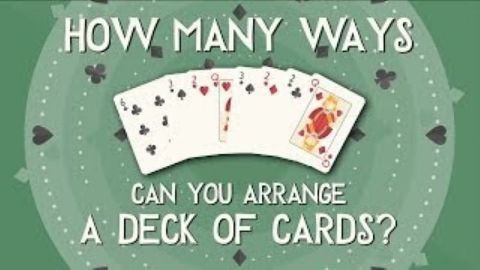
One deck. Fifty-two cards. How many arrangements? Let's put it this way: Any time you pick up a well shuffled deck, you are almost certainly holding an arrangement of cards that has never before existed and might not exist again. Yannay Khaikin explains how factorials allow us to pinpoint the exact (very large) number of permutations in a standard deck of cards.
Professor David Spiegelhalter tries to pin down what chance is and how it works in the real world. A blend of wit and wisdom, animation, graphics and gleeful nerdery is applied to the joys of chance and the mysteries of probability, the vital branch of mathematics that gives us a handle on what might happen in the future. How can you maximise your chances of living till you're 100? Why do many of us experience so many spooky coincidences? Should I take an umbrella? These are just some of the everyday questions the film tackles as it moves between Cambridge, Las Vegas, San Francisco and Reading. Spiegelhalter discovers One Million Random Digits, a book full of hidden patterns and shapes, introduces us to the unit called the micromort (a one-in-a-million chance of dying), and uses the latest infographics to demonstrate how life expectancy has increased in his lifetime and how it is affected by our lifestyle choices - drinking, obesity, smoking and exercise.
2012 • Math