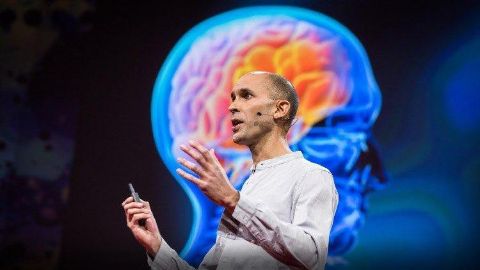
It’s true – some people hear colors, or taste words. But what produces synesthesia?
Hope you're finding these documentaries fascinating and eye-opening. It's just me, working hard behind the scenes to bring you this enriching content.
Running and maintaining a website like this takes time and resources. That's why I'm reaching out to you. If you appreciate what I do and would like to support my efforts, would you consider "buying me a coffee"?
BTC: bc1q8ldskxh4x9qnddhcrgcun8rtvddeldm2a07r2v
ETH: 0x5CCAAA1afc5c5D814129d99277dDb5A979672116
With your donation through , you can show your appreciation and help me keep this project going. Every contribution, no matter how small, makes a significant impact. It goes directly towards covering server costs.
Artificially intelligent machines are taking over. They’re influencing our everyday lives in profound and often invisible ways. They can read handwriting, interpret emotions, play games, and even act as personal assistants. They are in our phones, our cars, our doctors’ offices, our banks, our web searches…the list goes on and is rapidly growing ever longer. But how does today’s A.I. actually work—and is it truly intelligent? And for that matter, what is intelligence? The world’s brightest computer programmers are trying to build brighter machines by reverse-engineering the brain and by inventing completely new kinds of computers, with exponentially greater speed and processing power. NOVA Wonders looks at how far we’ve come and where machines are headed as their software becomes ever more…cerebral. How close are we from a world in which computers take over—from diagnosing cancer to driving our cars to targeting weapons? If we place more and more of our lives under the control of these artificial brains, what are we putting at risk?
Nova Wonders • 2018 • Brain
Comedian and impressionist Rory Bremner is on a personal mission to uncover the science of ADHD (attention deficit hyperactivity disorder), a condition which he has suspected he has. In this film, Rory learns about the science of ADHD, goes for a diagnosis and tries the drug methylphenidate (also known as Ritalin) for the first time - just before walking on stage. Around three per cent of the adult population suffer from ADHD (and five per cent of children), yet many people remain sceptical of its existence, blaming it on naughty children or bad parenting.
How does the creative brain work? Nancy Andreasen, neuroscientist and neuropsychiatrist, has spent her life studying the relationship between brain function, mental illnesses and the emergence and continuance of creativity.
S1E7 • Curiosity Retreats: 2015 Lectures • 2015 • Brain
What if each of us could make the symptoms of an illness disappear? Cast a spell so powerful it would actually rid us of pain, help us walk, or breathe better? For centuries placebos have been thought of as fake medicine involving trickery and deceit, but Brain Magic: The Power of Placebo pulls back the curtains on the proof that placebos can have powerful – and real – effects on our mind and body. New research is proving that everything from sugar pills, to saline injections, to sham surgery, can have real healing power. Placebos won’t shrink tumours or cure diabetes, but they can be effective in subjective conditions – where self-appraisal plays a role. And, as we’ll discover in Brain Magic, neuroscience is revealing how our bodies’ response to treatment is heavily influenced by our expectations, prior experiences, our beliefs, and the social cues that surround us.
S53E04 • The Nature of Things • 2015 • Brain
Are you in control of your brain, or is your brain controlling you? Dive into the latest research on the subconscious with neuroscientist Heather Berlin to see what’s really driving the decisions you make.
S1E2 • Your Brain • 2023 • Brain
Is your smart phone making you stupid? Can you make yourself cleverer? The Great British Intelligence Test measures the brainpower of the nation in one of the largest intelligence experiments of its kind. Devised with leading scientists at Imperial College, London, over 250,000 people around the nation have taken part so far - revealing important new science about the nation’s changing intelligence. Dr Hannah Fry and Michael Mosley put the public to the test, pitting young and old, males and females and tech lovers and readers against each other in a battle of wits. The audience can also play along online at www.bbc.co.uk/intelligencetest The results reveal new science about how our intelligence changes through our life. Which mental abilities peak in our 80s? And when can adults be outsmarted by ten-year-olds? It explores how our gender can affect our intelligence and uncovers groundbreaking new science on how our lifestyle and love of technology is changing our brain. Which of our digital habits are improving our mental abilities and which are harming us?