Neutrino: Hunting the Ghost Particle • 2021
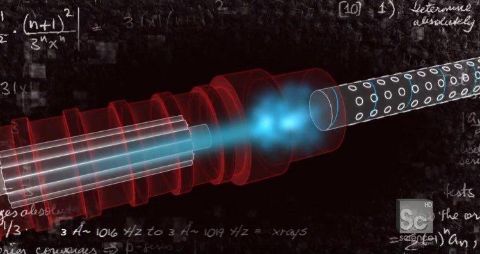
This is an astonishing tale of perseverance and ingenuity that reveals how scientists have battled against the odds for almost a century to detect and decode the neutrino, the smallest and strangest particle of matter in the universe. Inside the world-renowned physics laboratory Fermilab, a team of scientists are constructing an audacious experiment to hunt for a mysterious new 'ghost' neutrino. If they find it, this could transform our understanding of the nature and fabric of our universe. The problem is, these tiny particles are almost impossible to detect. Elsewhere, physicists conduct experiments in some of the most extreme environments on the planet: from deep mine shafts in South Dakota to vast ice fields at the South Pole. In these unlikely places supersized neutrino detectors hope to unlock the universe's deepest secrets. Could neutrinos overturn the most precise theory of particle physics that humans have ever written down? Could they even be a link to a hidden realm of new particles that permeate the cosmos - so called dark matter? Scientists at Fermilab are edging towards the truth.
Make a donation
Buy a brother a hot coffee? Or a cold beer?
Hope you're finding these documentaries fascinating and eye-opening. It's just me, working hard behind the scenes to bring you this enriching content.
Running and maintaining a website like this takes time and resources. That's why I'm reaching out to you. If you appreciate what I do and would like to support my efforts, would you consider "buying me a coffee"?
Donation addresses

BTC: bc1q8ldskxh4x9qnddhcrgcun8rtvddeldm2a07r2v
ETH: 0x5CCAAA1afc5c5D814129d99277dDb5A979672116
With your donation through , you can show your appreciation and help me keep this project going. Every contribution, no matter how small, makes a significant impact. It goes directly towards covering server costs.