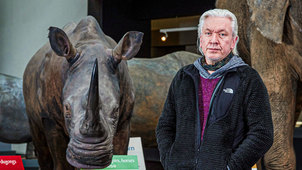
The museum's dinosaur experts Susie Maidment and Paul Barrett follow up an exciting tip-off about some possible dino footprints in Wales. Meanwhile, the world's most famous dinosaur - Dippy the Diplodocus - is on a road trip around the country and needs an up-close inspection to make sure it's safe.
Hope you're finding these documentaries fascinating and eye-opening. It's just me, working hard behind the scenes to bring you this enriching content.
Running and maintaining a website like this takes time and resources. That's why I'm reaching out to you. If you appreciate what I do and would like to support my efforts, would you consider "buying me a coffee"?
BTC: bc1q8ldskxh4x9qnddhcrgcun8rtvddeldm2a07r2v
ETH: 0x5CCAAA1afc5c5D814129d99277dDb5A979672116
With your donation through , you can show your appreciation and help me keep this project going. Every contribution, no matter how small, makes a significant impact. It goes directly towards covering server costs.
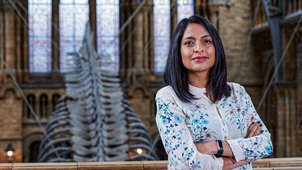
Every year, five million people visit London's Natural History Museum to see its incredible collection, from extraordinary dinosaurs to giant whales, and rare fossils to space rocks said to be as old as the solar system itself. But only a fraction of the staggering 80 million items in the collection are on display. Here cameras capture some of these incredible specimens, revealing the unique and rare pieces too valuable to exhibit.
2020 • Nature
The museum's dinosaur experts Susie Maidment and Paul Barrett follow up an exciting tip-off about some possible dino footprints in Wales. Meanwhile, the world's most famous dinosaur - Dippy the Diplodocus - is on a road trip around the country and needs an up-close inspection to make sure it's safe.
2020 • Nature
World-leading dinosaur expert Susie Maidment is in the museum basement trying to piece together the skeleton of the first Tyrannosaurus rex ever discovered. It's a priceless specimen but somehow the bones have got muddled up with another dinosaur and it's up to Susie to work out if any of the bits are missing. The experts inspect Guy the gorilla, who was a London Zoo favourite for decades and now sits fully preserved in his own glass case, and the museum launches an ambitious project to capture a sample of every living bug in the UK today.
2021 • Nature
Leading experts examine a rock in a crate of finds from an archaeological dig in Africa, which could contain a very rare 200-million-year-old dinosaur skull. The museum staff prepares for the Wildlife Photographer of the Year awards. Other artefacts from the museum featured in this episode include meteorite fragments that are older than the solar system and the oldest complete beetle specimens ever found in the UK.
2021 • Nature
This edition follows the plight of some of the youngest and most vulnerable of the mountain gorilla population. Includes the two young orphans whose mothers were callously murdered in execution-style killings, the young female battling with new emotions, and the new gorilla king struggling to keep hold of the group he fought so hard to win. Discover how they cope in this exploration of what the future holds for the remaining last few hundred mountain gorillas.
S1E3 • Mountain Gorilla • 2010 • Nature
Even after thousands of years of ice crushing the northern hemisphere and temperatures of 20 degrees lower than those of today, many of the great giants of the ice age still walked the earth. It was only when the world had warmed up again that mammoths, woolly rhinos, sabre-toothed cats, giant ground sloths and glyptodonts finally became extinct. Professor Alice Roberts sets off on her last voyage back to the Ice Age to discover why.
S1E3 • Ice Age Giants • 2013 • Nature
David Schwimmer visits a forgotten Brazilian rainforest.
S1E5 • Mysterious Planet • 2020 • Nature
David begins his journey inside the magnificent Palm House, a unique global rainforest in London. Here, he explores the extraordinary plants that are so well adapted to wet and humid environments and unravels the intimate relationships between wet zone plants and the animals that depend on them. It was in the wet zones of the world that plants first moved on to land and in the Waterlily House David reveals how flowers first evolved some 140 million years ago. Watching a kaleidoscope of breath-taking time-lapses of these most primitive of flowers swelling and blooming ...
S1E1 • Kingdom of Plants • 2012 • Nature
The Namib Desert is one of the oldest of all. It’s also one of the most diverse. With 50-degree temperatures and half a millimetre of rainfall annually, how is this possible?
S1E2 • Eden Untamed Planet • 2021 • Nature
David Attenborough takes a breathtaking journey through the vast and diverse continent of Africa as it has never been seen before. (Part 4: Cape) Southern Africa is a riot of life and colour because of two great ocean currents that sweep around the continent's Cape. To the east, the warm Agulhas current generates clouds that roll inland to the wettest place in southern Africa. To the west is the cold Benguela current, home to more great white sharks than anywhere else. Moisture laden fog rolls inland, supporting an incredible desert garden. Where the two currents meet, the clash of warm and cold water creates one of the world's most fabulous natural spectacles - South Africa's sardine run. This is the greatest gathering of predators on the planet, including Africa's largest, the Bryde's whale.