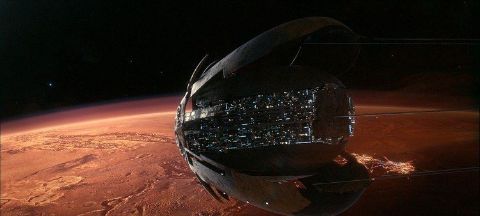
A look at the continuing evolution of the cosmos. What our existence tells us about the universe and how complicated it is. Why are things the way that they are? The spacecraft Artemis initiates launch sequence and begins its 4.7 light year journey to Minerva B - an Earth-like exoplanet.
Hope you're finding these documentaries fascinating and eye-opening. It's just me, working hard behind the scenes to bring you this enriching content.
Running and maintaining a website like this takes time and resources. That's why I'm reaching out to you. If you appreciate what I do and would like to support my efforts, would you consider "buying me a coffee"?
BTC: bc1q8ldskxh4x9qnddhcrgcun8rtvddeldm2a07r2v
ETH: 0x5CCAAA1afc5c5D814129d99277dDb5A979672116
With your donation through , you can show your appreciation and help me keep this project going. Every contribution, no matter how small, makes a significant impact. It goes directly towards covering server costs.
For as long as we’ve had eyes to see and minds to wonder we’ve marveled at the stars. Since the discovery of the first so-called exoplanet in 1994, the Planet Hunters have transformed the way we see the universe. It is the year 2157, and spacecraft Artemis enters the final phase of construction.
2018 • Astronomy
A look at the continuing evolution of the cosmos. What our existence tells us about the universe and how complicated it is. Why are things the way that they are? The spacecraft Artemis initiates launch sequence and begins its 4.7 light year journey to Minerva B - an Earth-like exoplanet.
2018 • Astronomy
Artemis arrives on the exoplanet Minerva B, but have they found evidence of life?
2018 • Astronomy
The new discovery of seven alien Earth-like planets in a faraway solar system is a major milestone in our hunt for extraterrestrial life, and experts investigate the secrets of TRAPPIST-1's mysterious worlds to reveal if we're truly alone in the universe.
Space's Deepest Secrets • 2018 • Astronomy
Astronaut Chris Hadfield has seen the bullet holes left by asteroids on Earth's surface. Our planet is vulnerable. Could we ever survive elsewhere?
6/10 • One Strange Rock • 2018 • Astronomy
The shape, contents and future of the universe are all intricately related. We know that it's mostly flat; we know that it's made up of baryonic matter (like stars and planets), but mostly dark matter and dark energy; and we know that it's expanding constantly, so that all stars will eventually burn out into a cold nothingness. Renée Hlozek expands on the beauty of this dark ending.
We reveal the planetary enigmas on our doorstep and embark on the New Horizons voyage to photograph Pluto. Will our encounter with this tiny ball of ice and rock and the trillions of icy objects beyond it paint a clearer picture of how the planets came to be?
S1E1 • The Planets • 2004 • Astronomy
To determine whether we're alone in the universe, astrobiologists look to Jupiter, Mars, and, closer to home, extreme environments on Earth.
2016 • Astronomy
The Large and Small Magellanic Clouds, luminous in the night sky of the Southern Hemisphere, are celestial bodies shrouded in mystery, but recent observations have revealed some startling facts about them. They are survivors of galaxies formed in the early stages of the Universe.
7 • Cosmic Front • 2014 • Astronomy