The siege of Paris in 885 was the culmination of the Viking invasions of Francia. We look at the persistent Viking attacks on Francia and the enduring presence of the Scandinavians on the Frankish Empire and beyond.
Hope you're finding these documentaries fascinating and eye-opening. It's just me, working hard behind the scenes to bring you this enriching content.
Running and maintaining a website like this takes time and resources. That's why I'm reaching out to you. If you appreciate what I do and would like to support my efforts, would you consider "buying me a coffee"?
BTC: bc1q8ldskxh4x9qnddhcrgcun8rtvddeldm2a07r2v
ETH: 0x5CCAAA1afc5c5D814129d99277dDb5A979672116
With your donation through , you can show your appreciation and help me keep this project going. Every contribution, no matter how small, makes a significant impact. It goes directly towards covering server costs.
An attack on a small religious community on the holy island of Lindisfarne in AD 793 heralded the start of the Viking Age of conquest and expansion. For 200 years, the longships from Scandinavia threatened all of Europe. But it was far from their first attack. We reveal how the Vikings' reign of terror began in Scandinavia.
2022 • History
The Siege of York occurred from 866 when the Great Heathen Army laid claim to the Northumbrian capital of York. We look at the major battles, players and strongholds of the York battle and how the Vikings later came to control much of the 9th Century England.
2022 • History
The "Silk Road" opened up a world of trade for the Scandinavians in the East. Seeking further wealth, the Vikings known in the East as "the Rus" attacked Constantinople in 860. The Rus became a permanent and feared fixture in the Byzantine Empire.
2022 • History
The siege of Paris in 885 was the culmination of the Viking invasions of Francia. We look at the persistent Viking attacks on Francia and the enduring presence of the Scandinavians on the Frankish Empire and beyond.
2022 • History
Political turmoil in Norway leads a voyage of discovery west. The Vikings discover Iceland where they established lasting settlement. Further exploration from Iceland leads to the discovery of Greenland and to the shores of Newfoundland, making them the first Europeans to discover America.
2022 • History
The mid-10th-century reign of Harald Bluetooth as king of a newly unified, powerful and Christianized Denmark marked the beginning of a second Viking age. But the reign was not to last with the Normans finally winning the English Kingdom in 1066. We look at the final days of the Viking empire.
2022 • History
A disease that developed and killed within a few days decimates Europe and changes the course of history.
S2E6 • Butterfly Effect • 2017 • History
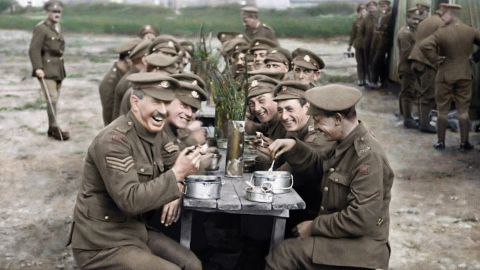
Academy Award winner Peter Jackson's poignant WWI documentary 'They Shall Not Grow Old' to commemorate the centennial of the end of the first World War. The acclaimed documentary is an extraordinary look at the soldiers and events of the Great War, using film footage captured at the time, now presented as the world has never seen. By utilizing state-of-the-art restoration, colorization and 3D technologies, and pulling from 600 hours of BBC archival interviews, Jackson puts forth an intensely gripping, immersive and authentic experience through the eyes and voices of the British soldiers who lived it. Jackson recorded a special introduction to the film offering his perspective on why the film is important for audiences, who have never experienced WWI footage as anything but grainy black & white, and silent. Jackson opens a window to the past in a way that has never been seen or heard before, noting, "Restoration is a humanizing process."
S1E3 • 2018 • History
In the History Channel Samurai – Miyamoto Musashi, Mark Dacascos, 8th dan Wun Hop Kuen Do expert, and martial arts movie actor, travels to Japan to trace the footsteps of the ultimate samurai warrior Miyamoto Musashi. They were the most lethal swordsmen who ever lived, an elite warrior class who held the reigns of power in Japan for more than 700 years. Among this group of powerful fighters, one man stood out above all the rest, Miyamoto Musashi. Originally the samurai's job was to serve the emperor, much the same way the legendary Knights of the Round Table were meant to serve King Arthur. The life of the Samurai changed when the country was in transition from one Shogun to another.
2009 • History
In 499 BC, Miletus, a Greek city in Asia Minor, revolted against the yoke of the Persian Empire with the support of the independent cities of Athens and Eretria. Darius, the great king of the Persian Empire, decided to avenge this affront by launching a punitive expedition against the rebel cities.
S1E1 • Battle For Athens • 2012 • History
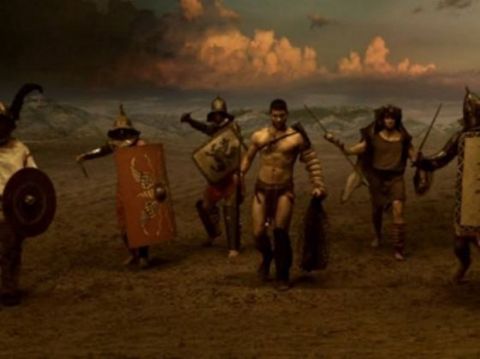
Up to one million gladiators are thought to have died in arenas across the Roman Empire. Seventy-five were recently found in a single cemetery in York. Two thousand years ago, York was a Roman stronghold, a staging ground for the push against the Scots. Apart from ancient Italy, Roman Britain had the highest density of gladiatorial arenas in Europe. As part of a routine building inspection in the outskirts of York, archaeologists discover an ancient Roman burial site. It soon became apparent the find was anything but routine. Of total 80, 75 of the skeletons were men, a much higher majority than would be expected in a family grave site. The height, build and signs of musculature made the men much bigger than that of the average Roman man. A closer inspection of the bones also revealed a number of cut marks and fractures, evidence the men were no strangers to violence. Most disturbing of all most of the men had been brutally decapitated. Could the men be gladiators?
2010 • History
In April 1944, two Jewish prisoners miraculously escaped from Auschwitz. When they recounted what they had left behind, their harrowing testimony revealed the true horror of the Holocaust to the outside world for the first time. They described in forensic detail the gas chambers and the full extent of the extermination programme. The news they brought presented the Allies with one of the greatest moral questions of the 20th century: Should we bomb Auschwitz? While the Allies deliberated in London and Washington, the killing machine ground on in southern Poland. One month after the men’s escape, almost 800,000 Hungarian Jews had been rounded up awaiting transport to Auschwitz. By early July 1944, the majority had been transported. Most of them were murdered on arrival. As the killing at Auschwitz reached its frenzied climax, the outcome of the Second World War hung in the balance. Millions of troops were fighting on both fronts and battling for supremacy in the air. Should the Allies use their resources to push on and win the war or to stop the industrial slaughter at Auschwitz? The request to bomb the camp, with 30,000 captive prisoners, was remarkable and came from a place of utter desperation. But it was a direct response to the destruction of an entire people. There were operational challenges - was it possible to reach the camp to bomb it? How many heavy bombers would it take? What would the Nazi propaganda machine say about such an attack? - as well as complex moral ones. How many prisoners would likely die in such a raid? Can you kill friendly civilians in order to save the lives of those being transported towards the death camp? These were the hard questions faced by Churchill, Allied Air Command and the Jewish Agency.
2019 • History