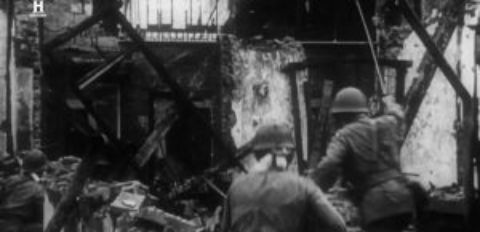
World War II was one of the definitive events of the 20th century, if not all of human history. John Green takes a look at the causes of World War II, the key event, as well as, both the short and long term effects of the war. For those interested in looking at World War II from a world perspective, this video focuses on the war before United States involvement.
Hope you're finding these documentaries fascinating and eye-opening. It's just me, working hard behind the scenes to bring you this enriching content.
Running and maintaining a website like this takes time and resources. That's why I'm reaching out to you. If you appreciate what I do and would like to support my efforts, would you consider "buying me a coffee"?
BTC: bc1q8ldskxh4x9qnddhcrgcun8rtvddeldm2a07r2v
ETH: 0x5CCAAA1afc5c5D814129d99277dDb5A979672116
With your donation through , you can show your appreciation and help me keep this project going. Every contribution, no matter how small, makes a significant impact. It goes directly towards covering server costs.
By assassinating nearly a third of Europe's workers in some countries, World War 1 reduced the militant mass to silence. But it was above all the repressive measures of the major democracies that, from deportations to executions, dealt a blow to the anarchist movement. In this fertile inter-war period, where capitalism gave birth to its two foul beasts, Stalinism and fascism, more than ever before, anarchism continued to be the only force of resistance for the people, in the face of the totalitarian hydra that was increasingly generalising theft and industrialising death. From Boston to Barcelona, from Tokyo to Paris, anarchism was to lead a struggle on all fronts. It was eventually in Spain, during the course of a war resembling a revolution that the movement finally came within reach of utopia.
S1E3 • No Gods, No Masters: A History of Anarchism • 2016 • History
On June 8th 793 Europe changed, forever. The famous monastery at Lindisfarne on the Northumbrian coast was suddenly attacked and looted by seafaring Scandinavians. The Viking Age had begun. Professor Alice Roberts examines how dramatically the story of the Vikings has changed on TV since the 1960s. She investigates how our focus has shifted from viewing them as brutal, pagan barbarians to pioneering traders, able to integrate into multiple cultures. We also discover that without their naval technology we would never have heard of the Vikings, how their huge trading empire spread, and their surprising legacy in the modern world.
A Timewatch Guide • 2017 • History
Americans are shocked by Hitler's massive counterattack in the Ardennes Forest--but by mid March, 1945, they are across the Rhine, while the Russians are 50 miles from Berlin. In the Pacific, after weeks of desperate fighting, Iwo Jima is secured, and American bombers begin a full-fledged air assault on Japan.
The Amazon rainforest is one of the enduring mysteries of the natural world - and no wonder, it is as big as the whole continental US! It’s home to over 2 million Indigenous peoples, and a massive 10…
S1E7 • History By The Numbers • 2021 • History
See how Idi Amin used lessons learned in the colonial British army to build a powerful dictatorship in Uganda. Through a combination of populist charm and brutal violence, he ruled for eight years until his strategic blunders brought him down.
S1E6 • The Dictator's Playbook • 2019 • History
Carter's dreams of change give way to Ronald Reagan. Gorbachev redeems Reagan and fresh opportunities for peace arise. The debate over Reagan's legacy.
S1E8 • Oliver Stone's Untold History of the United States • 2013 • History