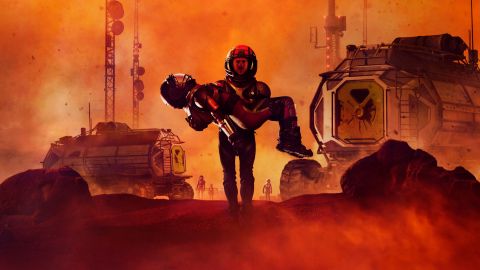
Ultra-sensitive telescopes have transformed alien planet-hunting from science fiction into enthralling hard fact. Join NOVA on a visit to exotic worlds orbiting distant suns to answer an age-old question with thrilling new science: are we alone?
Hope you're finding these documentaries fascinating and eye-opening. It's just me, working hard behind the scenes to bring you this enriching content.
Running and maintaining a website like this takes time and resources. That's why I'm reaching out to you. If you appreciate what I do and would like to support my efforts, would you consider "buying me a coffee"?
BTC: bc1q8ldskxh4x9qnddhcrgcun8rtvddeldm2a07r2v
ETH: 0x5CCAAA1afc5c5D814129d99277dDb5A979672116
With your donation through , you can show your appreciation and help me keep this project going. Every contribution, no matter how small, makes a significant impact. It goes directly towards covering server costs.
The sun is our life-giving source of light, heat, and energy, and new discoveries are unraveling its epic history. Join NOVA on a spectacular voyage to discover its place in a grand cycle of birth, death and renewal that makes this the age of stars.
2021 • Astronomy
Ultra-sensitive telescopes have transformed alien planet-hunting from science fiction into enthralling hard fact. Join NOVA on a visit to exotic worlds orbiting distant suns to answer an age-old question with thrilling new science: are we alone?
2021 • Astronomy
Take a seat on the ultimate thrill ride to explore nature’s strangest and most powerful objects. Discover new science showing how black holes reshape entire galaxies, warp the fabric of space and time, and might even be portals to another universe.
2021 • Astronomy
Everyone knows Neil Armstrong was the first to set foot on the moon. But this modest and unassuming man was determined to stay out of the spotlight. Now, for the first time, NOVA presents an intimate portrait of Armstrong through interviews with his family and friends, many of whom have never spoken publicly before.
Thanks to the wonders of physics, astronomers can map a timeline of the universe’s history. Today, Phil’s going to give you an overview of those first few minutes (yes, MINUTES) of the universe’s life. It started with a Big Bang, when the Universe was incredibly dense and hot. It expanded and cooled, going through multiple stages where different kinds of matter could form. It underwent a phenomenally rapid expansion called inflation, which smoothed out much of the lumpiness in the matter. Normal matter formed atoms between 3 and 20 minutes after the bang, and the lumps left over from inflation formed the galaxies and larger structures we see today.
44 • Crash Course Astronomy • 2016 • Astronomy
Carl Sagan talks about our place in the universe
9/10 • The Sagan Series • 1989 • Astronomy
Dead stars may be the key to understanding the cosmos. New research proves white dwarfs are one of the driving forces of our universe. They eat planets, they flare out in high-energy light Have scientists finally discovered how these small stars could be such massive galactic players?
S9E5 • How the Universe Works • 2021 • Astronomy
Planet Hunters follows the astrophysicists – many of them Canadian – at the forefront of the search for Earth's twin, and tells the little-known story of the two Canadians who invented the technique that made modern planet-hunting possible. Gordon Walker and Bruce Campbell also detected the first exoplanet ever discovered. But that's not what the history books say.
S52E04 • The Nature of Things • 2012 • Astronomy
The Known Universe takes viewers from the Himalayas through our atmosphere and the inky black of space to the afterglow of the Big Bang. Every star, planet, and quasar seen in the film is possible because of the world's most complete four-dimensional map of the universe, the Digital Universe Atlas that is maintained and updated by astrophysicists at the American Museum of Natural History.