History in the making; the inside story of the Artemis II mission around the moon and back. Four astronauts - Reid Wiseman, Victor Glover, Christina Koch and Jeremy Hansen - have just completed a ten-day mission going deeper into space than anyone has gone before. They are the first humans to circumnavigate the moon since 1972.
Hope you're finding these documentaries fascinating and eye-opening. It's just me, working hard behind the scenes to bring you this enriching content.
Running and maintaining a website like this takes time and resources. That's why I'm reaching out to you. If you appreciate what I do and would like to support my efforts, would you consider "buying me a coffee"?
BTC: bc1q8ldskxh4x9qnddhcrgcun8rtvddeldm2a07r2v
ETH: 0x5CCAAA1afc5c5D814129d99277dDb5A979672116
With your donation through , you can show your appreciation and help me keep this project going. Every contribution, no matter how small, makes a significant impact. It goes directly towards covering server costs.
A new age of space exploration, and exploitation, is dawning. But surprisingly, some of the boldest efforts at putting humans into space are now those of private companies started by a handful of maverick billionaire businessmen. Brian Cox gains exclusive access behind the scenes at Virgin Galactic, Blue Origin and Spaceport America, exploring what is really happening in privately financed space flight right now. From space tourism to asteroid mining, and even dreams of colonies on Mars, these new masters of the universe refuse to limit their imaginations. But are private companies led by Jeff Bezos, Sir Richard Branson and Elon Musk really going to be able to pull this off? How will they overcome the technical challenges to achieve it? And is it really a good idea, or just a fool's errand? Cox meets key players in the story - Bezos, founder of Blue Origin as well as Amazon, and Sir Richard Branson, founder of Virgin Galactic. He wants to find out how entrepreneurs - and engineers - really plan to overcome the daunting challenges of human space travel. It certainly hasn't been easy so far. Jeff Bezos has sold a further billion dollars of Amazon stock this year to fund Blue Origin. Branson has been working on Galactic for more than a decade. Lives have been lost. And some companies have already all but given up. But real progress has been made too. The origins of the new space boom, the X-prize in 2004, proved that reusable space craft could be built by private enterprise. Now the challenge is to work out how to run reliable, safe, affordable services that will show a return on the massive financial investments. Sixteen years since Dennis Tito became the first civilian in space, Cox explores the hardware and companies that are aiming to make daily tourist flights to space. Beyond mass space travel, and even space mining and manufacturing, the dream of Elon Musk and others is true space exploration. His company, SpaceX, already delivers supplies to the International Space Station, and their next step is delivering astronauts too. But their true ambition is to ensure the survival of the human race by crossing our solar system and colonizing Mars in the next decade. Could commercial spaceflight companies eventually make us a space-faring civilization?
2017 • Astronomy
The biggest question of our time. Are we alone? Chapter 1 of this experience takes you to alien worlds and distant places in time and space, in search of where alien life might be hiding and what our place is within the history of life. After generations of wondering, the truth is finally within our reach. New research and technologies have brought us closer than ever to an answer - only a few decades in the eyes of some NASA scientists.
melodysheep • 2020 • Astronomy
NASA’s Curiosity mission is on a quest to find life on Mars, but what they uncover could reveal far more than what anyone expected
S1E2 • Mars: The Secret Science Series 1 • 2014 • Astronomy
Scientists are only now starting to unravel the secrets of comets. Often referred to as dirty snowballs, they contain ice and elements from the very start of the universe. Some theorize that a comet, crashing into our planet, brought with it the organic material that started life on Earth. Spacecraft continues to offer new information on their makeup, from bringing back samples from a comet's tail to direct contact when a NASA-launched craft slammed into the comet Tempel-1.
Planet Science • 2007 • Astronomy
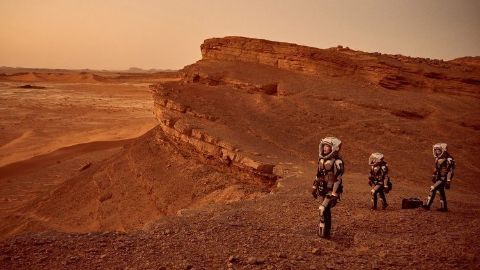
In 2033, the Daedalus crew struggles to find permanent shelter. Currently, the European Space Agency and Roscosmos partner to launch an orbiter.
In February 2019, after hurtling 300 million kilometers from Earth, the Japanese space probe Hayabusa 2 landed on the asteroid Ryugu. We follow the team behind the mission, as they sample parts of the asteroid and return it to our planet.
2020 • Astronomy