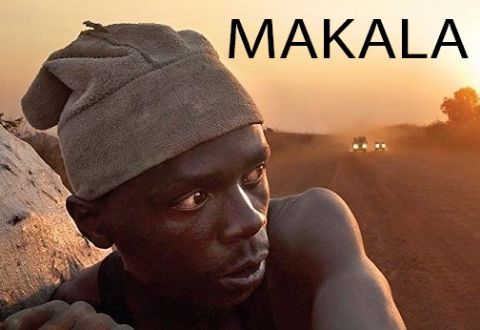
Kabwita Kasongo is a 28-year-old Congolese aspiring farmer with a young wife and three children. He earns a living making and selling charcoal while dreaming of a better future for his family. His only resources are the strength of his arms, the bushland around him, and his iron determination. When he sets out on a treacherous journey to the market in the nearest town where he hopes to sell his produce, he learns the true value of his efforts and the price he must pay to achieve his dreams.
Hope you're finding these documentaries fascinating and eye-opening. It's just me, working hard behind the scenes to bring you this enriching content.
Running and maintaining a website like this takes time and resources. That's why I'm reaching out to you. If you appreciate what I do and would like to support my efforts, would you consider "buying me a coffee"?
BTC: bc1q8ldskxh4x9qnddhcrgcun8rtvddeldm2a07r2v
ETH: 0x5CCAAA1afc5c5D814129d99277dDb5A979672116
With your donation through , you can show your appreciation and help me keep this project going. Every contribution, no matter how small, makes a significant impact. It goes directly towards covering server costs.
In the first of three episodes we learn how Rembrandt arrived in Amsterdam ‘like a thunderclap’ and was courted by the city’s wealthy elite, before falling into conflict with the city’s most powerful patrons. Jones explores the highs and lows of Rembrandt’s personal life too: from the new-found riches enjoyed with his wife, Saskia van Uylenburgh, to the tragedies that unfolded before him, leading to some of his most celebrated work.
S1E1 • Looking for Rembrandt • 2019 • People
Alice Roberts explores the latest discoveries in the study of human origins, revealing the transformation that has been brought about in this field by genetics. Traditional paleo-anthropology, based on fossils, is being transformed by advanced genome sequencing techniques. We now know that there were at least four other distinct species of human on the planet at the same time as us - some of them identified from astonishingly well-preserved DNA extracted from 50,000-year-old bones, others hinted at by archaic sections of DNA hidden in our modern genome. What's more, we now know that our ancestors met and interacted with these other humans, in ways that still have ramifications today. Alice uses these revelations to update our picture of the human family tree.
For decades, Korea and its people labor under Japanese imperialist rule. But in 1912, in a small town outside Pyongyang, a child is born, Kim Il Sung, coinciding with an omen of imperialism’s doom.
S1E1 • Inside North Korea's Dynasty • 2018 • People
Can we bridge the divide between "us" and "them"? At a time when the whole world seems to be polarizing into irreconcilable camps, Morgan Freeman sets out on a journey in search of the forces that push us apart, from intolerance of differences to fear of outsiders, and the possibilities of coming together.
S1E4 • The Story of Us with Morgan Freeman • 2017 • People
Sci-fi legend Robert Heinlein is a walking contradiction. His stories address themes of patriotism, and duty while stressing the importance of personal freedom and expression. His groundbreaking stories like Starship Troopers and Stranger in a Strange Land continue to challenge readers with a steadfast theme: what is freedom?
S1E7 • Prophets of Science Fiction • 2011 • People
Against all odds, African-American chemist Percy Julian became one of the great scientists of the 20th century. The grandson of Alabama slaves, Percy Julian met with every possible barrier in a deeply segregated America. He was a man of genius, devotion, and determination. As a black man he was also an outsider, fighting to make a place for himself in a profession and country divided by bigotry—a man who would eventually find freedom in the laboratory. By the time of his death, Julian had risen to the highest levels of scientific and personal achievement, overcoming countless obstacles to become a world-class scientist, a self-made millionaire, and a civil-rights pioneer.