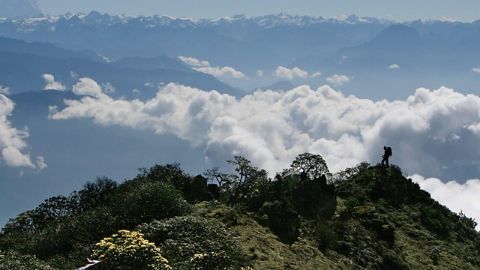
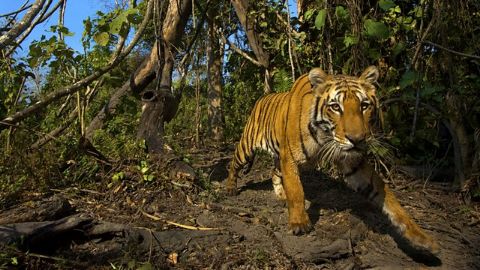
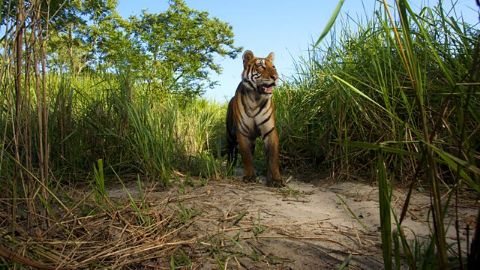
Wildlife adventure series searching for tigers in the Himalayas. Along the Tibetan border, explorer Steve Backshall has a close encounter with the world's most elusive predator.
Hope you're finding these documentaries fascinating and eye-opening. It's just me, working hard behind the scenes to bring you this enriching content.
Running and maintaining a website like this takes time and resources. That's why I'm reaching out to you. If you appreciate what I do and would like to support my efforts, would you consider "buying me a coffee"?
BTC: bc1q8ldskxh4x9qnddhcrgcun8rtvddeldm2a07r2v
ETH: 0x5CCAAA1afc5c5D814129d99277dDb5A979672116
With your donation through , you can show your appreciation and help me keep this project going. Every contribution, no matter how small, makes a significant impact. It goes directly towards covering server costs.
This programme surveys mammal herbivores and their predators. The herbivores began to populate the forests when the dinosaurs disappeared, and many took to gathering food at night. To prepare for winter, some store it in vast quantities, some hibernate and others make do as best they can. However, the carnivores joined them, and when a drying climate triggered the spread of grass, they followed their prey out on to the plains. Grass is not easily digestible and most animals that eat it have to regurgitate it and chew the cud. Out in the open, the leaf-eaters had to develop means of protection.
11/13 • Life on Earth • 1979 • Nature
In the Bahamas, Chris dives into one of the biggest questions in nature - how intelligence itself evolved, and how it arose in the dolphin's mind. Inside each is the result of a three-billion-year journey.
In New Zealand the travellers make their way through one of the most dramatic landscapes in the world. They are on a journey to find the last remaining kakapo, a fat, flightless parrot which, when threatened with attack, adopts a strategy of standing very still indeed.
S1E5 • Last Chance to See • 2009 • Nature
Steve finds out how washing our clothes is harming our marine life. Why has the fish and chips supper changed? And which lobster is making a comeback? Plus why is one man fascinated by 'the Christmas Tree fish of the sea? Chris finds out. Presented from Herne Bay in Kent .
S1E4 • Blue Planet UK • 2019 • Nature
Raising young in vast grasslands requires balancing plentiful resources with looming predatory threats.
S1E3 • Parenthood • 2025 • Nature
Sir David Attenborough chooses his favourite recordings from the natural world that have revolutionised our understanding of song. Each one - from the song of the largest lemur to the song of the humpback whale to the song of the lyrebird - was recorded in his lifetime. When Sir David was born, the science of song had already been transformed by Charles Darwin’s theory of sexual selection: singing is dangerous as it reveals the singer’s location to predators, but it also offers the male a huge reward, the chance to attract a female and pass on genes to the next generation. Hence males sing and females don't. Today, new science in the field of birdsong is transforming those long-held ideas. Scientists are discovering that, in fact, in the majority of all songbird species, females sing - and it is only now they are being properly heard. Through this revelation and others, we can understand that animal songs are marvelous examples of the spectacular survival strategies that species have developed in order to stay alive.
2021 • Nature