Americans are shocked by Hitler's massive counterattack in the Ardennes Forest--but by mid March, 1945, they are across the Rhine, while the Russians are 50 miles from Berlin. In the Pacific, after weeks of desperate fighting, Iwo Jima is secured, and American bombers begin a full-fledged air assault on Japan.
Hope you're finding these documentaries fascinating and eye-opening. It's just me, working hard behind the scenes to bring you this enriching content.
Running and maintaining a website like this takes time and resources. That's why I'm reaching out to you. If you appreciate what I do and would like to support my efforts, would you consider "buying me a coffee"?
BTC: bc1q8ldskxh4x9qnddhcrgcun8rtvddeldm2a07r2v
ETH: 0x5CCAAA1afc5c5D814129d99277dDb5A979672116
With your donation through , you can show your appreciation and help me keep this project going. Every contribution, no matter how small, makes a significant impact. It goes directly towards covering server costs.
The tranquil lives of the citizens of Mobile, AL; Sacramento, CA; Waterbury,CT; and Luverne, MN are shattered on December 7, 1941, as they, along with the rest of America are thrust into the greatest cataclysm in history.
2007 • History
Americans are shocked by terrible losses on the Pacific atoll of Tarawa, while in Italy Allied forces are stalled for months at Monte Cassino and a risky landing at Anzio fails utterly. At home, as overcrowded "war towns" boom, economic transformation leads to confrontation and ugly racial violence.
2007 • History
On June 6, 1944, D-Day, 1.5 million Allied troops take part in the greatest invasion in history, but then bog down in the Norman hedgerows for weeks. Saipan proves the costliest Pacific battle to date, while back home dreaded telegrams from the War Department begin arriving at an inconceivable rate.
2007 • History
Americans are shocked by Hitler's massive counterattack in the Ardennes Forest--but by mid March, 1945, they are across the Rhine, while the Russians are 50 miles from Berlin. In the Pacific, after weeks of desperate fighting, Iwo Jima is secured, and American bombers begin a full-fledged air assault on Japan.
2007 • History
A few weeks after the death of President Roosevelt shocks the country, Germany surrenders. Meanwhile, American sailors, soldiers and Marines endure the worst battle of the Pacific--Okinawa. In August, American planes drop atomic bombs on Hiroshima and Nagasaki, and the Japanese, too, surrender. Millions return home--to try to learn how to live in a world without war.
2007 • History
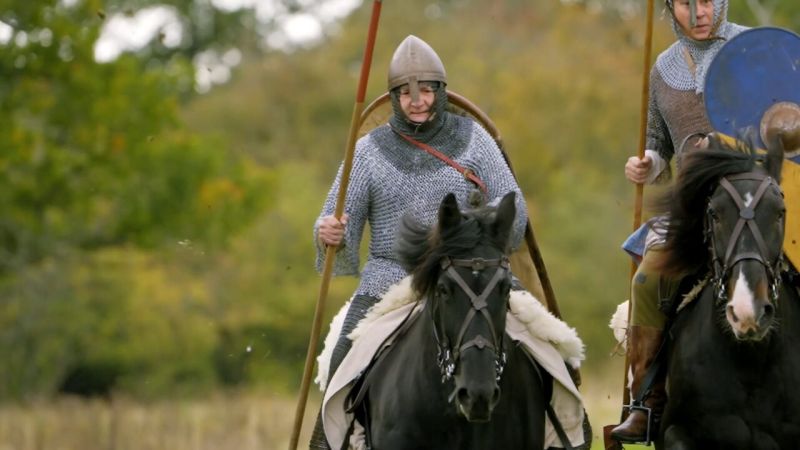
From battlefields and ancient swords to mighty castles and Durham cathedral, the rich, brutal story of William the Conqueror's journey from invader to ruler of England. Alice Roberts discovers who the Normans really were, tests a nearly thousand-year-old sword from William the Conqueror's time and wonders why there are so few women depicted in art from the time. Plus, Danielle George gets a brutal lesson in medieval 11th-century battlefield combat techniques, and Onyeka learns how William's coronation turned into a PR disaster.
S1E4 • Fortress Britain • 2022 • History
How did an insignificant cluster of Latin hill villages on the edge of the civilised world become the greatest empire the world has known? In the fifth programme of the series, archaeologist and historian Richard Miles examines the phenomenon of the Roman Republic, from its fratricidal mythical beginnings, with the legend of Romulus and Remus, to the all too real violence of its end, dragged to destruction by war lords like Pompey the Great and Julius Caesar. Travelling to Sicily and North Africa, Richard tells the story of Rome's century-long struggle for dominance with the other great regional power, Carthage. It was a struggle that would end with the total destruction of this formidable enemy and the transformation of landlubber Rome into a seapower, and the Republic into an Empire. But with no-one left to beat, the only enemy that Rome had left was itself.
S1E5 • Ancient Worlds • 2010 • History
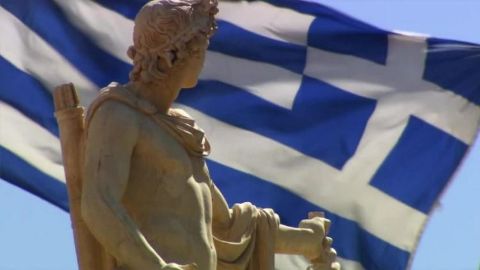
We explore the legacies of the Ancient Greeks, what they have given us today, and asks why these legacies have lasted through time. Democracy, art, architecture, philosophy, science, sport, theatre - all can be traced back to ancient Greece. Travelling across the ancient Greek world, from Athens to Olympia, Macedon, Turkey and Sicily, Michael discovers why the ancient Greeks were so successful, why their culture and way of life spread across continents and through time and why they still have such a powerful hold over our imaginations today.
S1E2 • Who Were the Greeks? • 2013 • History
Richard Miles explores the rise and fall of the Roman Empire, which at the height of its power, extended the benefits of its civilisation to a staggering 60 million subjects and citizens, from Hadrian's Wall to the banks of the Euphrates. The archaeologist and historian also learns how the expansion of Christianity filled a gap left by the Roman multi-god belief system, eventually leading to the instalment of Constantine as the first Christian emperor
S1E6 • Ancient Worlds • 2010 • History
Desperate to feed the Allied advance after D-Day, US forces target a deep water port in France during a month long siege against Nazi paratroopers.
S1E2 • Hitler's Last Stand • 2018 • History
For the people of the ancient world, the Huns were "the most feared of all warriors". Never before had people experienced such brutal fighting. The power of the mounted nomads became a threat to Rome, but other tribes were also on the move and headed to the center of a weakened empire.