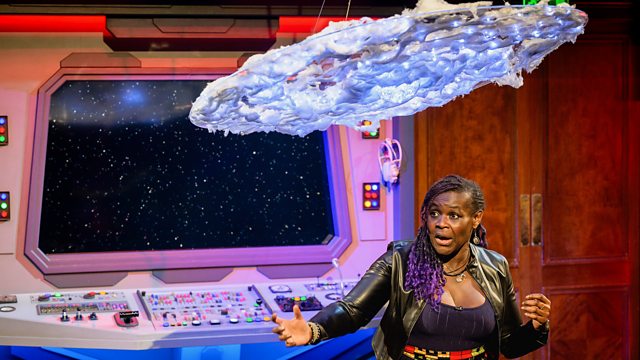
Dame Dr Maggie Aderin-Pocock, with the help of the world’s most powerful telescope, ventures through the Milky Way and into the universe beyond, on the hunt for alien worlds.
Hope you're finding these documentaries fascinating and eye-opening. It's just me, working hard behind the scenes to bring you this enriching content.
Running and maintaining a website like this takes time and resources. That's why I'm reaching out to you. If you appreciate what I do and would like to support my efforts, would you consider "buying me a coffee"?
BTC: bc1q8ldskxh4x9qnddhcrgcun8rtvddeldm2a07r2v
ETH: 0x5CCAAA1afc5c5D814129d99277dDb5A979672116
With your donation through , you can show your appreciation and help me keep this project going. Every contribution, no matter how small, makes a significant impact. It goes directly towards covering server costs.
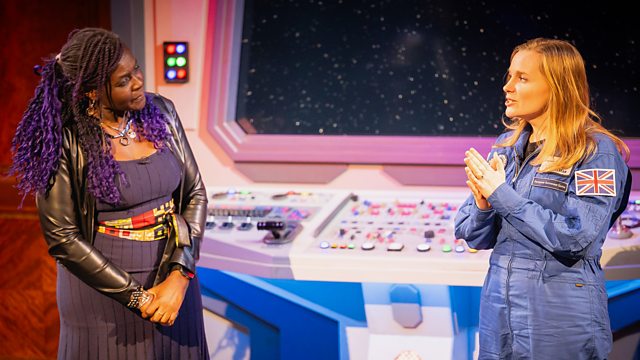
Dame Dr Maggie Aderin-Pocock begins her search for extraterrestrial life with an exploration of our nearest neighbour, and her favourite space rock, the moon.
2025 • Astronomy
Space scientist Dame Dr Maggie Aderin-Pocock continues her search for alien life with a grand tour of our solar system. Could any other planets or moons out there be habitable?
2025 • Astronomy
Dame Dr Maggie Aderin-Pocock, with the help of the world’s most powerful telescope, ventures through the Milky Way and into the universe beyond, on the hunt for alien worlds.
2025 • Astronomy
Flying through bad weather can be a harrowing experience, and for NASA, it can be doubly unnerving, as violent storms can strike from below the atmosphere or above it. Witness the true power of nature in space and on Earth as astronauts and ground crews battle to overcome the elements, including a severe lightning strike that crippled Apollo 12's computer system, the freezing temps that compromised the Space Shuttle Challenger, and the tempest of space debris that sent a dead satellite on a collision course with the International Space Station.
S1E5 • Space Disasters • 2020 • Astronomy
Untangling Alzheimer's is a dramatic and inspiring medical investigation driven by David Suzuki's journey to understand the science of Alzheimer's and the surprising new insights into its cause. David has a very personal interest in the disease because his mother, aunt and two uncles died of it. We join David on an intimate journey as he explores the newest breakthroughs in this devastating disease as well as his own chances of contracting the cruel condition. Alzheimer's today is the only leading cause of death that cannot be cured, prevented or even slowed. Worse, it's the only leading cause of death that is on the rise – and not simply because baby-boomers are getting older. Studies show that the increase is absolute across all age groups, and death rates continue to climb. With a new case developing every 69 seconds, scientists now speak of the Alzheimer's epidemic.
S53E06 • The Nature of Things • 2013 • Astronomy
Lunar days are about 14 Earth days long, and when night comes, temperatures plummet. But there are other issues to deal with as well. For instance, how can we overcome the moon's lack of atmosphere; difficult terrain with abrasive particles, and the effects of cosmic background radiation?
S1E4 • Destination: Moon • 2016 • Astronomy
On September 14th, 2015, a ripple in the fabric of space, created by the violent collision of two distant black holes over a billion years ago, washed across the Earth. As it did, two laser-based detectors, 50 years in the making – one in Louisiana and the other in Washington State – momentarily twitched, confirming a century-old prediction by Albert Einstein and marking the opening of a new era in astronomy. Join some of the very scientists responsible for this most anticipated discovery of our age and see how gravitational waves will be used to explore the universe like never before.
World Science Festival • 2016 • Astronomy
We strip apart the Sun and tear off boiling seas of plasma, light particles, and force fields layer by layer to explore the secrets that lie beneath the surface of Earth’s powerhouse.
S1E2 • Strip the Cosmos • 2014 • Astronomy
Professor Brian Cox fulfils a childhood dream by going behind the scenes at Nasa's Jet Propulsion Laboratory (JPL), mission control for Mars 2020 – one of the most ambitious missions ever launched that may finally reveal if life ever existed on the red planet. In 1980, a young Brian Cox wrote to JPL asking for photos from some of their missions to the planets. The pictures they sent him from Voyager and the Viking mission to Mars were a source of inspiration that set him on the path to becoming a physicist. Now, over 40 years later, he has been granted privileged access to JPL, including key mission areas that are usually off-limits to film crews. Brian spends a week following the team who guide the Perseverance rover and the Ingenuity helicopter - the first powered aircraft ever sent to another planet - across the surface of Mars during a critical stage of the mission. Perseverance's goal is to search for signs of long extinct life on the surface of Mars in an area called Jezero Crater, which, 3.8 billion years ago, was filled by a vast lake. If it finds evidence of that life, it could change everything we know about life in the universe - and even transform our understanding of our own origins.
2022 • Astronomy