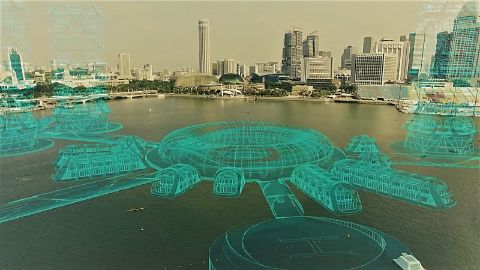
By 2065, the waters surrounding the island where Singapore lays may be dramatically impacted. Under such circumstances, living on the sea in floating communities would be commonplace while growing massive crops of food and generating power would become crucial to the city’s survival.
Hope you're finding these documentaries fascinating and eye-opening. It's just me, working hard behind the scenes to bring you this enriching content.
Running and maintaining a website like this takes time and resources. That's why I'm reaching out to you. If you appreciate what I do and would like to support my efforts, would you consider "buying me a coffee"?
BTC: bc1q8ldskxh4x9qnddhcrgcun8rtvddeldm2a07r2v
ETH: 0x5CCAAA1afc5c5D814129d99277dDb5A979672116
With your donation through , you can show your appreciation and help me keep this project going. Every contribution, no matter how small, makes a significant impact. It goes directly towards covering server costs.
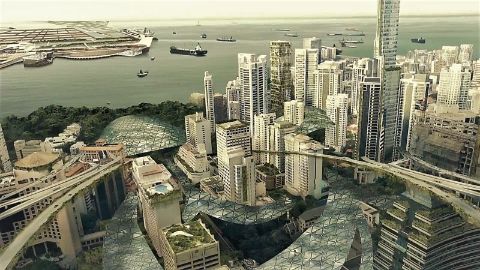
With its survival challenged by a rapidly growing and aging population and by accelerating climate change, where can land-poor Singapore expand? The futurists offer a radical solution: a massive vertical city. What will it be like living high up in the sky?
2018 • Technology
By 2065, the waters surrounding the island where Singapore lays may be dramatically impacted. Under such circumstances, living on the sea in floating communities would be commonplace while growing massive crops of food and generating power would become crucial to the city’s survival.
2018 • Technology
Today, GPS is guiding - and following - pretty much anything that moves, all around the world. It's so accurate it can track you down to the head of a pin. But where is GPS leading us? Is it helping us find the way, or lose it?
S2E1 • History 101 • 2022 • Technology
If people are the lifeblood of cities, then transport links are its veins and arteries. If they're cut off, the city will die. Thousands of people work every day at making it possible for city dwellers to be where they need to be, when they need to be there. It's an endless demand of brain and brawn. Without the army of drivers, diggers, and planners, our great cities would come to a halt.
S1E4 • How Cities Work • 2013 • Technology
Marcus Du Sautoy wants to find out how close we are to creating machines that can think like us: robots or computers that have artificial intelligence. His journey takes him to a strange and bizarre world where AI is now taking shape.
From the Stone Age to the Silicon Age, materials have helped drive forward our civilisation. By manipulating materials we have been able to transform our world and our lives - and never more so than in the past century when we have discovered and designed more materials than at any other time in human history. (Part 3: Ceramic) Professor Mark Miodownik traces the story of ceramics. He looks at how we started with simple clay, sand and rock and changed them into pottery, glass and concrete - materials that would allow us to build cities, transform the way we view our world and communicate at the speed of light. Deep within their inner structure Mark discovers some of ceramics' most intriguing secrets. He reveals why glass can be utterly transparent, why concrete continues to harden for hundreds of years and how cooling ceramics could transform the way we power cities of the future.
S1E3 • How It Works • 2012 • Technology
Eric Drexler, the "founding father of nanotechnology," and Jim Phillips, the CEO of Nanomech, discuss the potential applications and implications of nanotechnology. How will this atomically precise manufacturing impact the future of technology, global governance, and the environment?
4/10 • Curiosity Retreats: 2014 Lectures • 2014 • Technology
The inside story of the tech entrepreneurs who created the social media app Twitter. At first the site grew on the back of celebrities who realised it offered them a direct way to communicate with fans. After going global, it seemed to be fulfilling the founders' dream of a digital utopia where all voices would be heard. But as hate speech and misinformation flooded the platform, the founders faced growing problems to control it - and the sale to Elon Musk in 2022 represented the end of their dream.
2025 • Technology