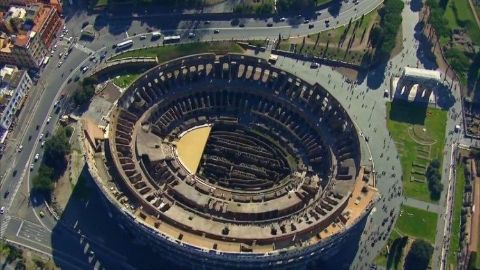
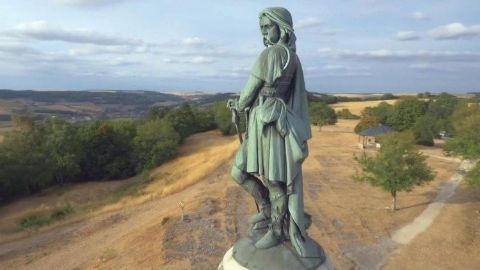
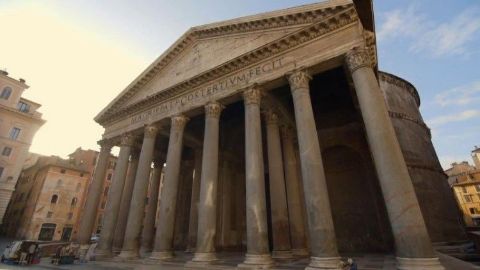
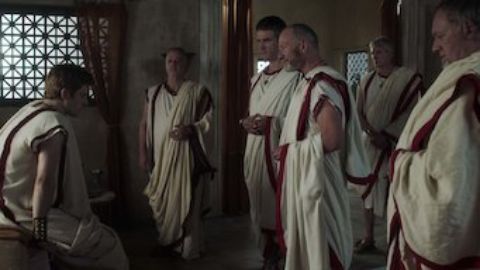
In the second episode, Mary Beard explores the physical world of the Roman Empire, and finds surprising parallels with our own world.
Hope you're finding these documentaries fascinating and eye-opening. It's just me, working hard behind the scenes to bring you this enriching content.
Running and maintaining a website like this takes time and resources. That's why I'm reaching out to you. If you appreciate what I do and would like to support my efforts, would you consider "buying me a coffee"?
BTC: bc1q8ldskxh4x9qnddhcrgcun8rtvddeldm2a07r2v
ETH: 0x5CCAAA1afc5c5D814129d99277dDb5A979672116
With your donation through , you can show your appreciation and help me keep this project going. Every contribution, no matter how small, makes a significant impact. It goes directly towards covering server costs.
In the region that includes the Mediterranean, the Aegean, Mesopotamia and Egypt, the Bronze Age arrived about 3000 BC and lasted nearly 2000 years. What singled out this period and the new societies and cities that emerged? The development of formal writing is one among several important factors.
S1E1 • Bronze Age • 2016 • History
How the Atlantic was conquered by air ranging from the pioneering epic of Lt Cdr Read USN in his Curtis flying boat and Alcock and Brown in their converted Vickers Vimy bomber in 1919, to Charles Lindbergh's epic solo crossing of 1927 and the record speed flights, including Concorde. Once man had conquered the power of flight, his next goal was to find a way to cross the Atlantic. The pioneer was Lt Commander Read of the US Navy who crossed the North Atlantic in a Curtiss NC-4 flying boat. In 1919 he was followed by Alcock and Brown in their converted Vickers Vimy bomber; and a few years later Charles Lindbergh made his epic solo flight across the Atlantic. In the following years the record breaking attempts were aimed at speed with Concorde's breaking of the sound barrier.
1/20 • The True Action Adventures of the Twentieth Century • 1996 • History
If knowledge is power, communication is the jet fuel, the delivery system, the gift we give each other that links the modern world. But it has a dark side.
S1E4 • Origins: The Journey of Humankind • 2017 • History
Between 1931 and 1933, 4 million Ukrainians were to die of hunger. This famine was not preceded by any cataclysmic weather event, nor by a war. This was an ideological crime: decided by Stalin and approved by the Politburo, with the aim of punishing Ukrainian peasants who refused the collectivization of the countryside, cultivated a strong form of nationalism and showed resistance to communist ideology. The purpose of this famine, unprecedented in Soviet history, was to break all forms of opposition. How was it implemented? What was known at the time? What was said? What was seen? The most important event in pre-war Soviet history is taboo: all traces of it were immediately erased, and the evidence drowned in a flood of lies. And yet, within just two years, this famine killed twice as many Ukrainians as the gulag did Soviets in half a century. This state secret was particularly well-kept for more than fifty years and only revealed in its full magnitude after the disintegration of the USSR, when the archives were revealed. Drawing on previously unpublished material, on many Soviet films and on a number of particular points of view, including that of Welsh journalist and whistleblower Gareth Jones, this film retraces the story of that famine.
2022 • History
The Poor Fellow-Soldiers of Christ and of the Temple of Solomon are known to history as the Knights Templar. They were among the most wealthy and powerful of all of the western military orders and for the 200 hundred years of their existence, were at the forefront of Christian finance. A look at the wealthiest of all the western military orders. Endorsed by the Catholic Church around 1129, these are Templar knights, and this is their story. If any single image epitomises the medieval era in the popular imagination, it is that of the heroic, chivalrous Knight. Clad in shining armour, his story was first told by authors in the 19th century before being carried on by Hollywood. But what are the truths behind the myths and legends? The Crusaders aims to find out.
S1E1 • The Crusaders • 2019 • History
France is in chaos. The French people take to the roads, trying to escape. The government signs an armistice as Germans take over half the country. May 1940. The French and the English retreat desperately. In Dunkirk, there are more than 300,000 troops waiting to be transhipped in hundreds of ships, which perform a heroic back and forth trips to England. Thousands of men perish at the sea, struck down by German bombs. Celebrated as heroes throughout Britain, the soldiers of Dunkirk were saved by the sacrifice of French soldiers. To take advantage of the booty, Mussolini's Italy attacked in turn in the Alps. Paris is emptying of millions of refugees who experience a desperate exodus on the roads, and the government surrender. The entry of two major figures does not change anything: on June 17 Petain was appointed head of state and calls for an end to the fight, when de Gaulle urges, on June 18, to resist. But the armistice was signed, in a ceremony desired by Hitler to reverse the humiliation of the Germans in 1918. Half occupied by the Germans, the other subject to the Vichy regime, France offered its coasts and airfields to the Germans who want to invade England. Will she be able to survive this Apocalypse better than France?
S1E2 • Apocalypse: Hitler Takes on the West • 2020 • History