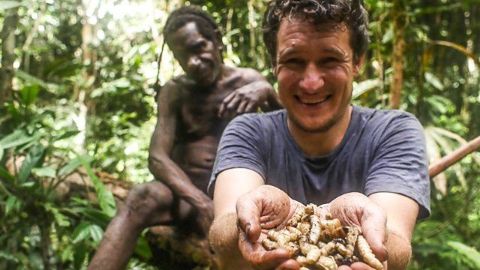
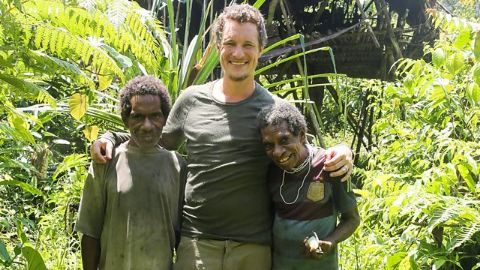
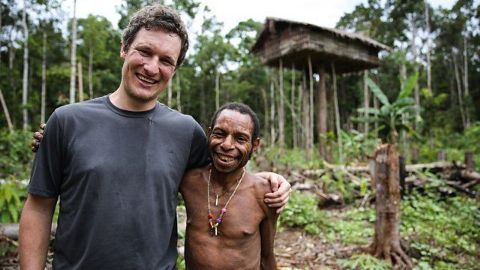
Will returns for his final two trips to Korowai territory, to try and find August and his family. He is keen to spend time with them too, to better understand how most Korowai live today.
Hope you're finding these documentaries fascinating and eye-opening. It's just me, working hard behind the scenes to bring you this enriching content.
Running and maintaining a website like this takes time and resources. That's why I'm reaching out to you. If you appreciate what I do and would like to support my efforts, would you consider "buying me a coffee"?
BTC: bc1q8ldskxh4x9qnddhcrgcun8rtvddeldm2a07r2v
ETH: 0x5CCAAA1afc5c5D814129d99277dDb5A979672116
With your donation through , you can show your appreciation and help me keep this project going. Every contribution, no matter how small, makes a significant impact. It goes directly towards covering server costs.
The life and work of M.C. Escher is presented primarily through his own words in the form of his writings being read against a backdrop of images associated to him, including archival footage of himself and images of his drawings. Many further details are provided by surviving family members. Escher himself considered what he did being caught between the worlds of art and mathematics - he not very good at either - his drawings always having an element of geometry. He made a conscious decision to work in monochromatic black and white realizing that he would be missing being able to convey ideas that are inherent with color. The evolution to two of his later periods is discussed, namely his series of drawings of the human eye, and what would become his ultimate fascination, that of the concept of infinity, whether it be real, as in the circle or the study of a man viewing a picture of himself viewing a picture of himself and so on, or perceived through illusions, such as his never-ending staircase. The documentary is buttressed by commentary from fan, musician Graham Nash who believes his brilliance has not yet been fully appreciated. Further Information
2021 • People
Jenny Clack recounts how she overcame setbacks before she found and described a fossil which offered new evidence of how fish made the transition onto land. For paleontologist Professor Jenny Clack, who solved one of the greatest mysteries in the history of life on Earth, success was far from inevitable. A chance discovery in 1986 in the earth sciences department of Cambridge University, of long-forgotten fossils collected from the Devonian rocks of East Greenland in 1970, was to shape the rest of her career. She recounts how she had to overcome a series of setbacks before she found and described the fossil Acanthostega, a 365 million-year-old creature that offered dramatic new evidence of how fish made the transition onto land. She authored or co-authored more than 120 research papers as well as numerous popular articles and book reviews. A measure of the significance of her work is that 15 of her research papers were published in the journal Nature. Her one book, "Gaining Ground, The Origin and Evolution of Tetrapods" (2002), summarises the results of research on early tetrapods over the previous 25 years.
S2E1 • Beautiful Minds • 2012 • People
Many technologies have promised to revolutionize education, but so far none has. With that in mind, what could revolutionize education?
Motherboard meets John Romero, one of the creators behind Wolfenstein 3D, DOOM, and Quake, breakthrough games that all but created the first-person shooter genre.
2015 • People
Louis Theroux travels from Miami to Marbella to meet the influencers shaping the online manosphere, examining how their hyper-masculine messaging is reshaping young men’s ideas about gender, power and identity.
2026 • People
It’s weird to hear how your voice really sounds. But why does it sound different to you?