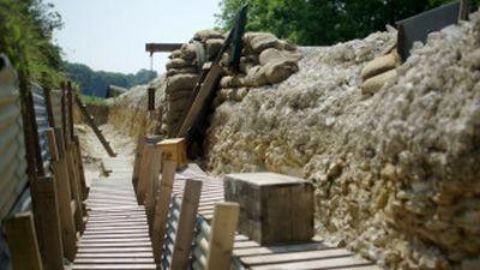
By the beginning of 1915 the horrific killing power of machine guns and artillery had taught all sides that the only way to survive was to find shelter and dig in.
Hope you're finding these documentaries fascinating and eye-opening. It's just me, working hard behind the scenes to bring you this enriching content.
Running and maintaining a website like this takes time and resources. That's why I'm reaching out to you. If you appreciate what I do and would like to support my efforts, would you consider "buying me a coffee"?
BTC: bc1q8ldskxh4x9qnddhcrgcun8rtvddeldm2a07r2v
ETH: 0x5CCAAA1afc5c5D814129d99277dDb5A979672116
With your donation through , you can show your appreciation and help me keep this project going. Every contribution, no matter how small, makes a significant impact. It goes directly towards covering server costs.
The opening episode tells the story of the outbreak of war in 1914. In the decades since the last European War the world changed.
2017 • History
By the beginning of 1915 the horrific killing power of machine guns and artillery had taught all sides that the only way to survive was to find shelter and dig in.
2017 • History
How the First World War transformed life on the home front, from a greater number of women in the workplace to increased government interference in everyday life.
2017 • History
The numbers will favoured one side, then the other in 1918. When the Bolsheviks took Russia out of the war, millions of German and Austro-Hungarian troops were freed up to attack Britain and Belgium, France and Italy. But across the Atlantic, America was training an army of two-million men.
2017 • History
Rome was the world's first ancient megacity. At a time when few towns could number more than 10,000 inhabitants, more than a million lived in Rome. But in a world without modern technology, how on earth did the Romans do it? How did they feed their burgeoning population, how did they house them, and how did they get them into town without buses or trains? How on earth did the Romans make their great city work? In the final episode of the series, Professor Andrew Wallace-Hadrill takes us up ancient tower blocks, down ancient sewers, and above 2,000-year-old harbour basins still filled with water, to find out. He reveals how this city surpassed all those from the ancient world that had gone before. Last but not least, Professor Wallace-Hadrill uncovers the secret of Rome's success - the planning still captured on pieces of an 1,800-year-old marble map of the city, a map which shows that astonishingly, in many places, the street plan of Ancient Rome mirrors that of the city today in exact detail.
S1E2 • Building the Ancient City: Athens and Rome • 2015 • History
The Germanic tribes strike as Marcus Aurelius succumbs to disease, leaving a skeptical Emperor Commodus to prosecute a war that doesn't interest him.
S1E2 • Roman Empire • 2016 • History
From a simple act of trade to today's global economy, the meaning of money and what we value changes as civilization evolves.
S1E3 • Origins: The Journey of Humankind • 2017 • History
In the History Channel Samurai – Miyamoto Musashi, Mark Dacascos, 8th dan Wun Hop Kuen Do expert, and martial arts movie actor, travels to Japan to trace the footsteps of the ultimate samurai warrior Miyamoto Musashi. They were the most lethal swordsmen who ever lived, an elite warrior class who held the reigns of power in Japan for more than 700 years. Among this group of powerful fighters, one man stood out above all the rest, Miyamoto Musashi. Originally the samurai's job was to serve the emperor, much the same way the legendary Knights of the Round Table were meant to serve King Arthur. The life of the Samurai changed when the country was in transition from one Shogun to another.
2009 • History
A treasure map leads to the discovery of a lost fortress; a sacred altar is unearthed, revealing secrets of the legendary Maya Snake King uprising; Albert Lin travels to a remote jungle, where technology reveals evidence of a forgotten war.
S1E1 • Lost Treasures of the Maya • 2019 • History
In the heart of a metropolitan city of 15 million people and among the construction of a new billion-dollar transportation network, an archaeological sensation has been discovered: the ancient harbour of Theodosious. Theodosious was the last ruler over both Eastern and Western portions of a unified Roman Empire; the harbour has been buried and shrouded in mystery for over 800 years…until now. Istanbul, Turkey, is situated exactly between Europe and Asia. It has, since prehistoric times, bridged the gap between these continents, their cultures and its people. Engineers are working to connect East to West through a spectacular 1.4 kilometer railway tunnel, 60 meters below the surface, but they've been stalled by the discovery of the Emperor's Lost Harbor.
S51E05 • The Nature of Things • 2011 • History