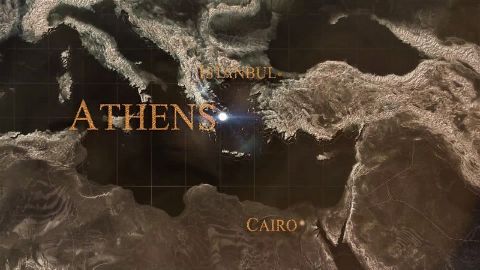
Istanbul: At the crossroads of Europe and Asia, many of its secrets are concealed or underground. The latest 3D imaging technology reveals the city as no human eye ever could to show how the city has had to reinvent itself over and over through its turbulent past.
Hope you're finding these documentaries fascinating and eye-opening. It's just me, working hard behind the scenes to bring you this enriching content.
Running and maintaining a website like this takes time and resources. That's why I'm reaching out to you. If you appreciate what I do and would like to support my efforts, would you consider "buying me a coffee"?
BTC: bc1q8ldskxh4x9qnddhcrgcun8rtvddeldm2a07r2v
ETH: 0x5CCAAA1afc5c5D814129d99277dDb5A979672116
With your donation through , you can show your appreciation and help me keep this project going. Every contribution, no matter how small, makes a significant impact. It goes directly towards covering server costs.
Continuing his fascinating journey to rediscover the central role played by the Ottoman empire in Europe and the Middle East, Rageh Omaar explores the huge contrasts in the times of two very different Ottoman sultans. The most famous Suleiman the Magnificent in the golden age of the 16th century and the troubled reign of Abdul Hamid II in the 19th century when the Ottomans were dubbed 'the Sick Man of Europe'. Rageh examines the cultural legacy as well as the physical, religious and political architecture of Ottoman rule to find out what a Muslim world run from Europe was really like. It reveals the backdrop to the relationship between Islam and Europe today, how the Ottomans became central in the power politics of Europe and what could have happened had they succeeded in their successive bids to seize Vienna, then a key European capital.
S1E2 • The Ottomans: Europe's Muslim Emperors • 2013 • History
An attack on a small religious community on the holy island of Lindisfarne in AD 793 heralded the start of the Viking Age of conquest and expansion. For 200 years, the longships from Scandinavia threatened all of Europe. But it was far from their first attack. We reveal how the Vikings' reign of terror began in Scandinavia.
S1E1 • Vikings: The Rise and Fall • 2022 • History
Today it is easy to see D-Day as inevitable - a straightforward victory against a German army that was already all but defeated. This film explodes that myth. It charts the careful planning of the campaign, the development of specialised equipment needed for the amphibious landing. It reveals the deception plan that wrong footed Hitler. It shows how the Americans were very nearly driven off Omaha beach. If that had happened, the whole operation might have failed. The film ends with the Liberation of Paris, as the Free French forces led by Charles de Gaulle matched down the streets of the capital.
9/13 • World War II In HD Colour • 2009 • History
The Romans were brilliant engineers and soldiers, but what isn't as well known is that they also gave us wonderful artistic treasures. In this three-part series, Alastair Sooke argues that the old-fashioned view that the Romans didn't do art is nonsense. He traces how the Romans during the Republic went from being art thieves and copycats to pioneering a new artistic style - warts 'n' all realism. Roman portraits reveal what the great names from history, men like Julius Caesar and Cicero, actually looked like. Modern-day artists demonstrate the ingenious techniques used to create these true to life masterpieces in marble, bronze and paint. We can step back into the Roman world thanks to their invention of the documentary-style marble relief and to a volcano called Vesuvius. Sooke explores the remarkable artistic legacy of Pompeii before showing how Rome's first emperor, Augustus, used the power of art to help forge an empire.
S1E1 • The Treasures of Ancient Rome • 2012 • History
1916, the Great War, far away from the trenches, in the sand of the Middle East, war has a very different face. With a handful of intrepid men, Thomas Edward Lawrence leads the revolt of the Arabs alongside Sharif Hussein, against the Ottoman Empire.
S3E7 • Butterfly Effect • 2018 • History
Dr Helen Castor explores the life - and death - of Joan of Arc. Joan was an extraordinary figure - a female warrior in an age that believed women couldn't fight, let alone lead an army. But Joan was driven by faith, and today more than ever we are acutely aware of the power of faith to drive actions for good or ill. Since her death, Joan has become an icon for almost everyone - the left and the right, Catholics and Protestants, traditionalists and feminists. But where in all of this is the real Joan - the experiences of a teenage peasant girl who achieved the seemingly impossible? Through an astonishing manuscript, we can hear Joan's own words at her trial, and as Helen unpicks Joan's story and places her back in the world that she inhabited, the real human Joan emerges.
2015 • History