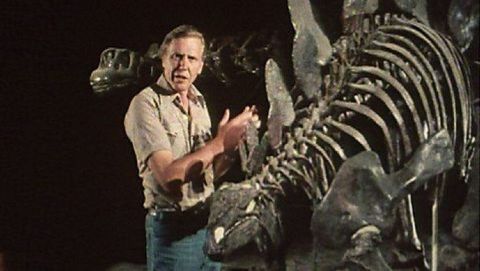
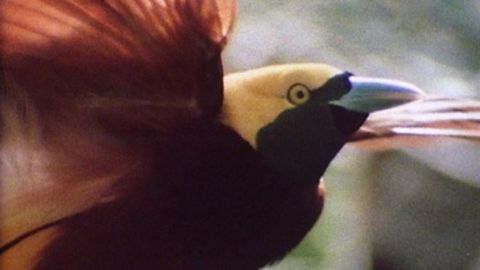
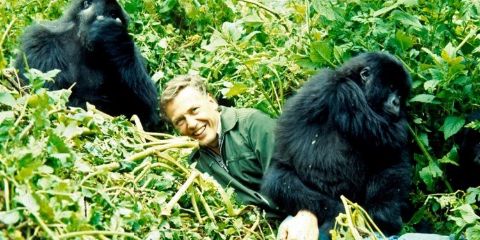
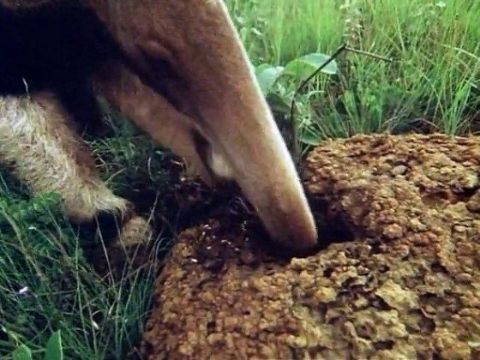
The penultimate instalment investigates the primates, whose defining characteristics are forward-facing eyes for judging distance, and gripping hands with which to grasp branches, manipulate food and groom one another. The programme begins in Madagascar, home to the lemurs, of which there are some 20 different types. Two examples are the sifaka, which is a specialised jumper, and the indri, which has a well-developed voice. Away from Madagascar, the only lemur relatives to have survived are nocturnal, such as the bushbaby, the potto and the loris. The others were supplanted by the monkeys and a primitive species that still exists is the smallest, the marmoset. However, Attenborough selects the squirrel monkey as being typical of the group. Howler monkeys demonstrate why they are so named their chorus is said to the loudest of any mammal and their prehensile tails illustrate their agility.
Hope you're finding these documentaries fascinating and eye-opening. It's just me, working hard behind the scenes to bring you this enriching content.
Running and maintaining a website like this takes time and resources. That's why I'm reaching out to you. If you appreciate what I do and would like to support my efforts, would you consider "buying me a coffee"?
BTC: bc1q8ldskxh4x9qnddhcrgcun8rtvddeldm2a07r2v
ETH: 0x5CCAAA1afc5c5D814129d99277dDb5A979672116
With your donation through , you can show your appreciation and help me keep this project going. Every contribution, no matter how small, makes a significant impact. It goes directly towards covering server costs.
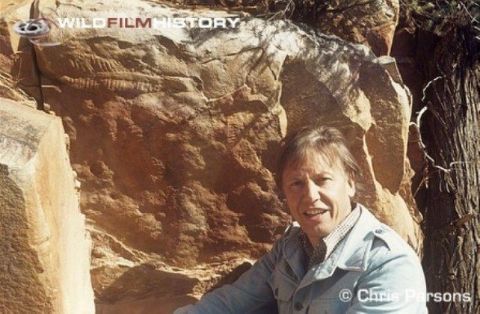
The episode begins in the South American rainforest whose rich variety of life forms is used to illustrate the sheer number of different species. Since many are dependent on others for food or means of reproduction, David Attenborough argues that they couldn't all have appeared at once. He sets out to discover which came first, and the reasons for such diversity. He starts by explaining the theories of Charles Darwin and the process of natural selection, using the giant tortoises of the Galapagos Islands (where Darwin voyaged on HMS Beagle) as an example. Fossils provide evidence of the earliest life, and Attenborough travels a vertical mile into the Grand Canyon in search of them.
1979 • Nature
The next programme explores the various sea-living invertebrates. In Morocco, the limestones are 600 million years old, and contain many invertebrate fossils. They fall broadly into three categories: shells, crinoids and segmented shells. The evolution of shelled creatures is demonstrated with the flatworm, which eventually changed its body shape when burrowing became a necessity for either food or safety. It then evolved shielded tentacles and the casings eventually enveloped the entire body: these creatures are the brachiopods. The most successful shelled animals are the molluscs, of which there are some 80,000 different species.
1979 • Nature
This instalment examines the earliest land vegetation and insects. The first plants, being devoid of stems, mainly comprised mosses and liverworts. Using both sexual and asexual methods of reproduction, they proliferated. Descended from segmented sea creatures, millipedes were among the first to take advantage of such a habitat and were quickly followed by other species. Without water to carry eggs, bodily contact between the sexes was now necessary. This was problematical for some hunters, such as spiders and scorpions, who developed courtship rituals to ensure that the female didn't eat the male.
1979 • Nature
This episode details the relationship between flowers and insects. There are some one million classified species of insect, and two or three times as many that are yet to be labelled. Around 300 million years ago, plants began to enlist insects to help with their reproduction, and they did so with flowers. Although the magnolia, for instance, contains male and female cells, pollination from another plant is preferable as it ensures greater variation and thus evolution. Flowers advertise themselves by either scent or display. Some evolved to produce sweet-smelling nectar and in turn, several insects developed their mouth parts into feeding tubes in order to reach it.
1979 • Nature
The next instalment describes the move from water to land. The fish that did so may have been forced to because of drought, or chose to in search of food. Either way, they eventually evolved into amphibians. Such creatures needed two things: limbs for mobility and lungs to breathe. The coelacanth is shown as a fish with bony fins that could have developed into legs, and the lungfish is able to absorb gaseous oxygen. However, evidence of an animal that possessed both is presented in the 450 million-year-old fossilised remains of a fish called a eusthenopteron. Three groups of amphibians are explored.
1979 • Nature
This episode is devoted to the evolution of reptiles. They are not as restricted as their amphibian ancestors, since they can survive in the hottest climates. The reason is their scaly, practically watertight skin. The scales protect the body from wear and tear and in the case of some species of lizard, such as the Australian thorny devil, serve to protect from attack. The horned iguana from the West Indies is also one of the most heavily armoured. The skin is rich in pigment cells, which provide effective means of camouflage, and the chameleon is a well-known example. Temperature control is important to reptiles: they cant generate body heat internally or sweat to keep cool.
1979 • Nature
This programme focuses on birds. The feather is key to everything that is crucial about a bird: it is both its aerofoil and its insulator. The earliest feathers were found on a fossilised Archaeopteryx skeleton in Bavaria. However, it had claws on its wings and there is only one species alive today that does so: the hoatzin, whose chicks possess them for about a week or so. Nevertheless, it serves to illustrate the probable movement of its ancestor. It may have taken to the trees to avoid predators, and over time, its bony, reptilian tail was replaced by feathers and its heavy jaw evolved into a keratin beak.
1979 • Nature
This instalment is the first of several to concentrate on mammals. The platypus and the echidna are the only mammals that lay eggs (in much the same manner of reptiles), and it is from such animals that others in the group evolved. Since mammals have warm blood and most have dense fur, they can hunt at night when temperatures drop. It is for this reason that they became more successful than their reptile ancestors, who needed to heat themselves externally. Much of the programme is devoted to marsupials (whose young are partially formed at birth) of which fossils have been found in the Americas dating back 60 million years.
1979 • Nature
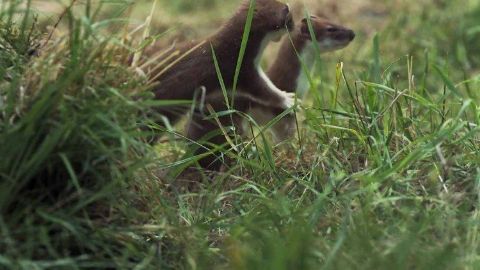
This episode continues the study of mammals, and particularly those whose young gestate inside their bodies. Attenborough asks why these have become so varied and tries to discover the common theme that links them. Examples of primitive mammals that are still alive today include the treeshrew, the desman and the star-nosed mole. Insect eaters vary enormously from the aardvark, giant anteater and pangolin to those to which much of this programme is devoted: the bats, of which there are nearly 1,000 different species. These took to flying at night, and its possible that they evolved from treeshrews that jumped from tree to tree, in much the same way as a flying squirrel.
1979 • Nature
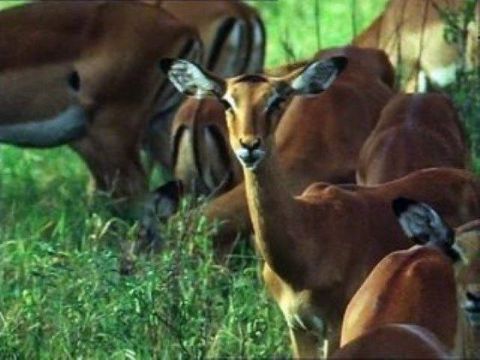
This programme surveys mammal herbivores and their predators. The herbivores began to populate the forests when the dinosaurs disappeared, and many took to gathering food at night. To prepare for winter, some store it in vast quantities, some hibernate and others make do as best they can. However, the carnivores joined them, and when a drying climate triggered the spread of grass, they followed their prey out on to the plains. Grass is not easily digestible and most animals that eat it have to regurgitate it and chew the cud. Out in the open, the leaf-eaters had to develop means of protection.
1979 • Nature
The penultimate instalment investigates the primates, whose defining characteristics are forward-facing eyes for judging distance, and gripping hands with which to grasp branches, manipulate food and groom one another. The programme begins in Madagascar, home to the lemurs, of which there are some 20 different types. Two examples are the sifaka, which is a specialised jumper, and the indri, which has a well-developed voice. Away from Madagascar, the only lemur relatives to have survived are nocturnal, such as the bushbaby, the potto and the loris. The others were supplanted by the monkeys and a primitive species that still exists is the smallest, the marmoset. However, Attenborough selects the squirrel monkey as being typical of the group. Howler monkeys demonstrate why they are so named their chorus is said to the loudest of any mammal and their prehensile tails illustrate their agility.
1979 • Nature
The final episode deals with the evolution of the most widespread and dominant species on Earth: humans. The story begins in Africa, where, some 10 million years ago, apes descended from the trees and ventured out into the open grasslands in search of food. They slowly adapted to the habitat and grew in size. Their acute sense of vision led to them standing erect to spot predators, leaving their hands free to bear weapons. In addition, the primitive apemen also had stones that were chipped into cutting tools. Slowly, they grew taller and more upright, and their stone implements became ever more elaborate.
1979 • Nature
David Attenborough highlights the curiosities that have led to accusations of forgery, but have ultimately helped assist the rethinking of evolution. When early explorers brought the first specimen of a duck-billed platypus to England in 1799, it was considered so bizarre it was deemed a hoax. Similarly, the midwife toad became the centre of a scientific storm in the 1920s that led to accusations of fakery.
S1E2 • Natural Curiosities • 2013 • Nature
David Attenborough examines more creatures that have fascinated us for centuries. A look at some species with remarkable healing properties.
S3E5 • Natural Curiosities • Nature
Spring arrives in the polar regions, and the sun appears after an absence of five months; warmth and life return to these magical ice worlds - the greatest seasonal transformation on our planet is underway. Male Adelie penguins arrive in Antarctica to build their nests - it takes a good property to attract the best mates and the males will stop at nothing to better their rivals! But these early birds face the fiercest storms on the planet. In the Arctic, a polar bear mother is hunting with her cubs. Inland, the frozen rivers start to break up and billions of tons of ice are swept downstream in the greatest of polar spectacles. This melt-water fertilizes the Arctic Ocean, feeding vast shoals of Arctic cod and narwhal. The influx of freshwater accelerates the breakup of the sea-ice - an area of ice the size of Australia will soon vanish from the Arctic. On land, a woolly bear caterpillar emerges from the snow having spent the winter frozen solid. Caterpillars normally become moths within months of hatching, but life is so harsh here that the woolly bear takes 14 years to reach adulthood. Once mature it has only days to find a mate before it dies! Alongside the caterpillars white Arctic wolves race to raise their adorable cubs before the cold returns.
S1E2 • Frozen Planet • 2011 • Nature
A captivating world of creepy crawlies exists all around us. And they are the biggest group of animals in the world, outnumbering humans 200 million to one. Thanks to millions of years of evolution, these invertebrates not only survive in almost every landscape known to man, but also thrive by means of fascinating, and sometimes bizarre adaptations. There's the Bombardier beetle that squirts a boiling hot liquid from its anus, the Assassin bug that turns its victims into soup, and the Parasitic wasp that lays her eggs inside her victims, until her young are ready to eat their way out. We end off with the biggest bugs on the planet: the Atlas moth with a wingspan of over 20 centimetres, the Hercules beetle that can carry 850 times its own weight, and the Giant centipede - big enough to catch flying bats from midair!
2015 • Nature
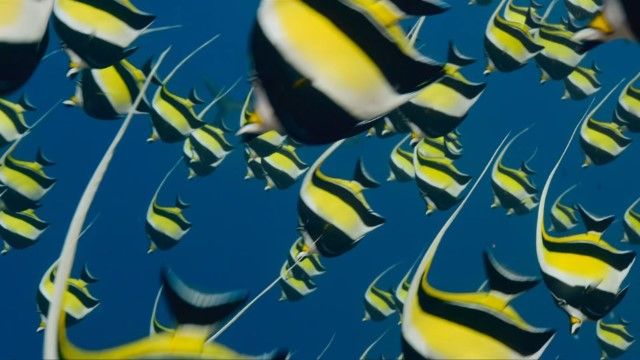
David Attenborough narrates a natural history of the oceans to uncover the strange, otherworldly creatures living in the depths of the ocean.
S1E2 • Blue Planet I • 2001 • Nature
Huge changes have swept across Arabia since the discovery of oil and the Arab relationship with nature has changed too. This is summed up by the changes to camel racing, now an ultra hi-tech sport. Arabia's animals now live alongside a very modern society but Arabia's people are using technology to protect nature: dugongs are fitted with satellite transmitters; hunting falcons chase down radio-controlled planes and the world's first carbon-neutral city is being built in the very heart of oil country.
S1E3 • Wild Arabia • 2013 • Nature