Discover how plants sense, communicate, and make complex decisions, revealing a hidden intelligence that challenges what we think life is capable of.
Hope you're finding these documentaries fascinating and eye-opening. It's just me, working hard behind the scenes to bring you this enriching content.
Running and maintaining a website like this takes time and resources. That's why I'm reaching out to you. If you appreciate what I do and would like to support my efforts, would you consider "buying me a coffee"?
BTC: bc1q8ldskxh4x9qnddhcrgcun8rtvddeldm2a07r2v
ETH: 0x5CCAAA1afc5c5D814129d99277dDb5A979672116
With your donation through , you can show your appreciation and help me keep this project going. Every contribution, no matter how small, makes a significant impact. It goes directly towards covering server costs.
Discover how plants sense, communicate, and make complex decisions, revealing a hidden intelligence that challenges what we think life is capable of.
2024 • Nature
Explore the remarkable survival strategies of plants as they adapt, defend, and thrive in ever-changing environments.
2024 • Nature
Travel the the globe to experience the vital connection between humans, animals, and our planet through stunning, rarely before seen footage which exposes the effects that deforestation have had on endangered species.
2022 • Nature
In Namibia, Gordon joins a cheetah conservationist who wants to see if three orphaned cheetahs, which she has raised from a day old, can learn to hunt effectively in the thick vegetation. The on-board cameras, the first to ever be worn by cheetahs hunting in Africa, In Australia, the team puts cameras on fur seals to try to see how they hunt their prey and avoid attacks by great white sharks. In South Africa, we deploy the first ever cameras on wild baboons in an effort to understand why these clever monkeys sometimes raid farmers' crops.
S1E2 • Animals with Cameras • 2018 • Nature
The single spiral tusk of the narwhal inspiration for tales of unicorns and the myriad variations on the twist of the snail shell have delighted and fascinated naturalists and artists since the dawn of civilization.
S1E4 • Natural Curiosities • Nature
The era of the sabretooth and many other Pleistocene creatures comes to an end. The biggest big cats ever, the lion and the tiger, become the kings of their respective habitats - but they had to fight for their place. To survive, these great cats target larger and more challenging prey.
S1E2 • Age of Big Cats • 2018 • Nature
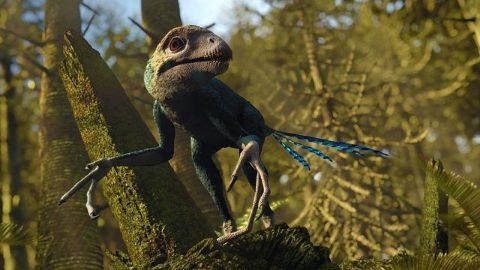
The second episode of the documentary series takes a look at bizarre and extraordinary feathered dinosaurs, many of which have only just been discovered. These feathered beasts are revolutionising our understanding of life on Earth as they blur the boundaries between what we know of dinosaurs and birds. China sits at the heart of the feathered dinosaur discoveries and is the home of one of the most unusual discoveries on Earth: the epidexipteryx. Only the size of a pigeon, this predator was the most bird-like of any dinosaur and is the first known case of ornamental feathers. But feathers were not just confined to the small. From caudipteryx to sinosauropteryx and the 8-metre-long gigantoraptor, feathers may have been used for flight, for insulation or even to intimate and attract. These dinosaurs not only hint at how animals might have developed flight, but also suggest that dinosaurs may still live among us today - as birds.
S1E2 • Planet Dinosaur • 2011 • Nature
The Galapagos Islands are home to some animals that washed up on the islands millions of years ago and have made adaptations. Penguins, iguanas, tortoises and cormorants have changed so they can survive the harsh climate. But possibly the oddest adaptation is that of the Vampire finch.
S1E2 • Wild Galapagos • 2017 • Nature