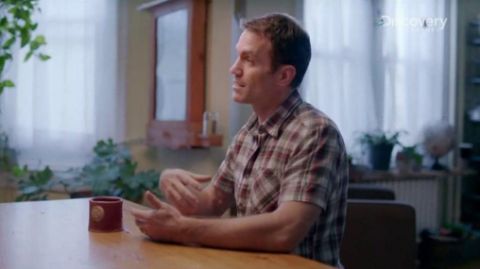
Todd Sampson puts brain training to the test. A pioneer in the neuroplasticity revolution, Michael Merzenich, mentors Todd, showing him how to radically improve his cognition by turbocharging his thinking speed, attention and memory.
Hope you're finding these documentaries fascinating and eye-opening. It's just me, working hard behind the scenes to bring you this enriching content.
Running and maintaining a website like this takes time and resources. That's why I'm reaching out to you. If you appreciate what I do and would like to support my efforts, would you consider "buying me a coffee"?
BTC: bc1q8ldskxh4x9qnddhcrgcun8rtvddeldm2a07r2v
ETH: 0x5CCAAA1afc5c5D814129d99277dDb5A979672116
With your donation through , you can show your appreciation and help me keep this project going. Every contribution, no matter how small, makes a significant impact. It goes directly towards covering server costs.
Todd Sampson puts brain training to the test. A pioneer in the neuroplasticity revolution, Michael Merzenich, mentors Todd, showing him how to radically improve his cognition by turbocharging his thinking speed, attention and memory.
2013 • Brain
Todd puts brain training to the test in Make Me Creative, as he trains his brain to be more creative, innovative and to think more laterally, before attempting a creative art challenge.
2013 • Brain
Todd trains hard to improve his body intelligence, visualization skills, and emotional intelligence before attempting a super-human feat. He faces his greatest fear - being chained, handcuffed and blindfolded underwater with only his radically improved brain to help him escape.
2013 • Nature
Todd uses the latest science to train his brain to become more adaptable. To prove that it's possible, he risks his life rock climbing blindfolded up a 120m rock face in Utah's Moab Desert.
2015 • Brain
Todd pushes his senses to the limits to unleash his brain's full potential.
2015 • Brain
To prove that brain training can overcome fear, Todd uses all his previous brain training to face his fears and achieve the ultimate challenge - a skywalk between two buildings 21 floors high.
2015 • Brain
Artificially intelligent machines are taking over. They’re influencing our everyday lives in profound and often invisible ways. They can read handwriting, interpret emotions, play games, and even act as personal assistants. They are in our phones, our cars, our doctors’ offices, our banks, our web searches…the list goes on and is rapidly growing ever longer. But how does today’s A.I. actually work—and is it truly intelligent? And for that matter, what is intelligence? The world’s brightest computer programmers are trying to build brighter machines by reverse-engineering the brain and by inventing completely new kinds of computers, with exponentially greater speed and processing power. NOVA Wonders looks at how far we’ve come and where machines are headed as their software becomes ever more…cerebral. How close are we from a world in which computers take over—from diagnosing cancer to driving our cars to targeting weapons? If we place more and more of our lives under the control of these artificial brains, what are we putting at risk?
Nova Wonders • 2018 • Brain
An investigation into hate, produced by Steven Spielberg and Alex Gibney. Cognitive scientist Laurie Santos examines how tribalism shapes perceptions of other groups.
S1E2 • Why We Hate • 2019 • Brain
Renowned neurosurgeon Henry?Marsh, reflecting on decades of life-and-death decisions and now facing his own terminal illness, revisits haunting failures and searching for redemption in a deeply personal and emotionally powerful journey.
Jim Al-Khalili goes on a journey through 600 million years of evolution to uncover how the human brain, the most complex structure known in the universe, came to exist. Chapter 1: With some 100 billion neurons and over 100 trillion connections - more than all the stars in the Milky Way - the human brain is one of nature's greatest achievements. But how did something so incredibly sophisticated evolve from its simple beginnings? Chapter 2: Jim watches primates in action to see how they tackle survival challenges, revealing the clever tricks that shaped the brain's thinking. But the real breakthrough came when brains learned to be social. Teaming up with his wife, Jim investigates how relationships and friendships made people more intelligent. With AI getting smarter by the day, Jim wants to know what makes biological brains so special. Through scans, fossil discoveries and cutting-edge research, he uncovers what makes the brain so hard to emulate.
What new methods of analysis have been developed in the age-old struggle to discover if someone is telling the truth...or not? Some scientists have gone beyond the polygraph to model other ways of detecting whether we are getting a straight answer or being led down a crooked path.
2017 • Brain
If I could live forever, should I? How does being reminded of our own mortality affect us psychologically? In this episode I speak with mortician and death positivity activist Caitlin Doughty and visit a cryonics facility trying to extend human life indefinitely. Will I take them up on their offer, or will I choose to die?
S3E5 • Mind Field • 2018 • Brain