Hunting and Escaping
Life-and-death duels are fought daily in the wild: an orchid turns out to be a predator, killer whales ambush sea lions and chimps pursue colobus…
Life-and-death duels are fought daily in the wild: an orchid turns out to be a predator, killer whales ambush sea lions and chimps pursue colobus…
The search for food in the animal world. With leaves defended by poisons and seeds clad in thorns, animals fight back in very innovative ways.
For animals, there is no greater challenge than surviving the vulnerable first years of life. This episode demonstrates that nature's solutions are…
An examination of the diverse techniques employed by animals to disperse and protect offspring.
Mankind takes on godlike powers: to feed billions of people, reshape the landscape, re-engineer the human body. The greatest power of all was…
Captured in a single, animated time lapsed shot, and based on archeological findings, we trace our epic journey from the first spark of life billions…
The final episode deals with the evolution of the most widespread and dominant species on Earth: humans. The story begins in Africa, where, some 10…
The penultimate instalment investigates the primates, whose defining characteristics are forward-facing eyes for judging distance, and gripping hands…
This programme surveys mammal herbivores and their predators. The herbivores began to populate the forests when the dinosaurs disappeared, and many…
This episode continues the study of mammals, and particularly those whose young gestate inside their bodies. Attenborough asks why these have become…
This instalment is the first of several to concentrate on mammals. The platypus and the echidna are the only mammals that lay eggs (in much the same…
This programme focuses on birds. The feather is key to everything that is crucial about a bird: it is both its aerofoil and its insulator. The…
This episode is devoted to the evolution of reptiles. They are not as restricted as their amphibian ancestors, since they can survive in the hottest…
The next instalment describes the move from water to land. The fish that did so may have been forced to because of drought, or chose to in search of…
This episode details the relationship between flowers and insects. There are some one million classified species of insect, and two or three times as…
This instalment examines the earliest land vegetation and insects. The first plants, being devoid of stems, mainly comprised mosses and liverworts…
The next programme explores the various sea-living invertebrates. In Morocco, the limestones are 600 million years old, and contain many invertebrate…
The episode begins in the South American rainforest whose rich variety of life forms is used to illustrate the sheer number of different species…
Death is life's greatest certainty. But that may be about to change. Scientists have discovered an immortal animal that may hold the secret of…
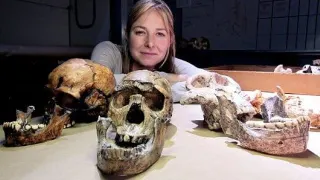
Alice Roberts explores the latest discoveries in the study of human origins, revealing the transformation that has been brought about in this field…
Fortey travels to Madeira to examine what happens to a volcanic island as it nears the end of its life-cycle and starts sinking back into the sea…
Fortey travels to the rainforests of Madagascar - an ancient island that has spawned some of the most extraordinary groups of plants and animals…
Fortey is on Hawaii to investigate how life colonises a newly-born island. The most remote island group in the world, by some estimates only one new…
New Zealand was one of the last land masses to be found and settled by people. Lush and fertile, almost everything brought here flourishes, often…
The most extreme and wild parts of New Zealand are in the South Island, which lie towards Antarctica, in the path of the tempestuous 'roaring…
Isolated since the time of the dinosaurs, New Zealand's wildlife has been left to its own devices, with surprising consequences. Its ancient forests…
When Homo sapiens turned up in prehistoric Europe, they ran into the Neanderthals. The two types of human were similar enough to interbreed — and…
When Homo sapiens arrived in Australia, they were, for the first time, truly alone, surrounded by wildly different flora and fauna. How did they…
What happened when early humans ventured out of Africa and into Asia? Where did they go and whom did they meet along the way? The latest evidence…
Around 200,000 years ago, a new species, Homo sapiens, appeared on the African landscape. While scientists have imagined eastern Africa as a…
As early humans spread out across the world, their toughest challenge was colonizing the Americas — because a huge ice sheet blocked the route. It…
Animal Reunions have captured the imaginations of millions of people worldwide. YouTube is full of animal reunion stories - moments that illustrate…
Liz Bonnin presents a controversial and provocative episode of Horizon, investigating how new scientific research is raising hard questions about…
Early humans eventually colonized Australia, the South Pacific, and the Americas. But how did our ancestors master the oceans? Learn how new…
How did we become our planet's only global species, at home in every environment on Earth. Learn how our ancestors found a way through the deserts…
Like other kinds of human who once shared our world, homo sapiens should have died away. Discover how our species faced near extinction in Africa…
Artificial selection is one example, eyes another, of the well-documented and inescapable process of evolution--change in a population of species…
In the final episode Dr Alice Roberts explores how our species, homo sapiens, developed our large brain; and asks why we are the only one of our kind…
David Attenborough explores the courtship displays of flame bowerbirds and pufferfish.
To gain power an animal must find a way to rise through the ranks of its society.
The moment when all animals must strike out on their own in search of independence.