Panspermia
It's not as crazy as it sounds: life on Earth could be descended from space-faring microbes from Mars, or even further beyond, riding here on an…
It's not as crazy as it sounds: life on Earth could be descended from space-faring microbes from Mars, or even further beyond, riding here on an…
The team explores one of the greatest discoveries of modern astronomy - that our universe is expanding - and the new questions it raises about how…
The universe isn't just a vast empty ocean sprinkled with galaxies – most of the atoms are actually drifting in between, in the intergalactic medium…
How do these objects differ from one another, if at all? Nick Moskovitz, an astronomer at the Lowell Observatory, compares these space solar system…
Space technologies are continuing to be refined and access to space is becoming cheaper. This episode looks at the development of new human-rated…
The most important planet in the solar system is our home, the Earth. It is the only planet we know that harbors life. This episode looks at the…
As our expertise in space technology increases, there have been spin-offs in many areas: particularly in communications. This episode examines the…
There are so many unanswered questions about the stars, the galaxies, and the universe and just mapping what lies in the night sky is immensely…
The largest things in the universe are black holes. In contrast to things like planets or stars they have no physical size limit, and can literally…
Neutron stars are one of the most extreme and violent things in the universe. Giant atomic nuclei, only a few kilometers in diameter but as massive…
The Hayabusa2 spacecraft has just completed one of the most intricate procedures in space exploration. The first mission to deliver rovers onto an…
Deep in the mountains of West Virginia, the Green Bank Observatory has been receiving a mysterious signal from deep space. Could this be a message…
The fate of the Mars InSight lander will all come down to a fiery seven-minute freefall into the Red Planet. Will it survive and reveal new insight…
Explained examines the possibility of extraterrestrial life and looks at why we have not yet found evidence for its existence despite efforts to look…
Our universe is prone to increasing disorder and chaos. So how did it generate the extreme complexity we see in life? Actually, the laws of physics…
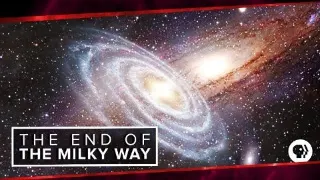
The Andromeda galaxy is heading straight toward our own Milky Way. The two galaxies will inevitably collide. Will that be the very last night sky our…
The US efforts to colonize the Moon will follow the Lunar Exploration Roadmap, laid out with events taking place over decades. Other countries have…
Commander Stephen Hawking takes another journey in his space ship, the SS Hawking, this time to Venus, the Sun and out to the Eagle Nebula...but…
Is there anyone out there? Does the popular movie quote 'ET phone home' have any substance? Astronomers have been pointing their radio telescopes at…
The Earth, the sun, the stars, and everything we can see, only comprise five percent of the universe. But what about the other 95 percent? Scientists…
"That's home. That's us. On it, everyone you ever heard of, every human being who ever lived.."
Carl Sagan talks about our place in the universe
Humanity's first steps on the Moon.
Carl Sagan talks about our future and the exploration of space
"You might have thought, as I did then, that our species would be on Mars before the century was over"
Our species has discovered a way to communicate through the dark, to transcend immense distances
"It is beyond our powers to predict the future"
Carl Sagan talks about religion and the universe
It's our fate to live in the dark...
What are our frontiers?
Commander Stephen Hawking pilots his space ship the SS Hawking on the journey of a lifetime, zooming from black holes to the Big Bang, Saturn to…
Professor Brian Cox probes our moment of creation. How did our Universe come into existence? Was there a time before the Big Bang? Do our laws of…
Set to the words of Carl Sagan, Pale Blue Dot is an animation that situates human history against the tapestry of the cosmos. Using a eclectic…
Here it is, folks: the end. In our final episode of Crash Course Astronomy, Phil gives the course a send off with a look at some of his favorite…
As we approach the end of Crash Course Astronomy, it’s time now to acknowledge that our Universe’s days are numbered. Stars will die out after a few…
Thanks to the wonders of physics, astronomers can map a timeline of the universe’s history. Today, Phil’s going to give you an overview of those…
The majority of the universe is made up of a currently mysterious entity that pervades space: dark energy. We don’t know exactly what it is, but we…
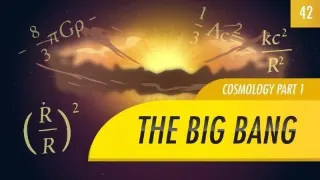
Thanks to observations of galaxy redshifts, we can tell that the universe is EXPANDING! Knowing that the universe is expanding and how quickly its…
No, it is not a planet :)
We’ve covered a lot of incredible stuff, but this week we’re talking about the weirdest objects in space: BLACK HOLES. Stellar mass black holes form…
In the aftermath of a 8 – 20 solar mass star’s demise we find a weird little object known as a neutron star. Neutrons stars are incredibly dense…
Massive stars fuse heavier elements in their cores than lower mass stars. This leads to the creation of heavier elements up to iron. Iron robs…
Today Phil follows up last week’s look at the death of low mass stars with what comes next: a white dwarf. White dwarfs are incredibly hot and dense…
Today we are talking about the life -- and death -- of stars. Low mass stars live a long time, fusing all their hydrogen into helium over a trillion…
While Jupiter is nowhere near massive enough to initiate fusion in its core, there are even more massive objects out there that fall just short of…
Today Phil explains that YES, there are other planets out there and astonomers have a lot of methods for detecting them. Nearly 2000 have been found…
Today Phil’s explaining the stars and how they can be categorized using their spectra. Together with their distance, this provides a wealth of…
How do astronomers make sense out of the vastness of space? How do they study things so far away? Today Phil talks about distances, going back to…