Race to the Red Planet
Scientists and modern explorers are determined to send humans to Mars; as NASA builds its first spacecraft to carry astronauts to Mars and tech…
Scientists and modern explorers are determined to send humans to Mars; as NASA builds its first spacecraft to carry astronauts to Mars and tech…
From Luke Skywalker's light sabre to Darth Vader's Death Star, the Star Wars franchise is one of the defining science fiction works of the later 20th…
Sci-fi legend Robert Heinlein is a walking contradiction. His stories address themes of patriotism, and duty while stressing the importance of…
He put a man on the Moon in the Victorian Era. He criticized the Internet...in 1863. Jules Verne is the ultimate futurist, with a legacy of sci-fi…
He saved the future from Evil Robots! Isaac Asimov dreamed a better future where we need not fear our own technology. His I, Robot stories of a…
"I told you so..." H.G. Wells' self penned epitaph underscores a lifetime of grim yet uncanny prophecy. With stories like The Time Machine, The…
Literary genius, celebrated visionary, paranoid outcast: Writer Philip K. Dick lived a life of ever-shifting realities straight from the pages of his…
Recent discoveries could explain how supermassive black holes grow so big, one of the universe's most mysterious questions. Neither dark matter nor…
Meet Nikola Tesla, the genius engineer and tireless inventor whose technology revolutionized the electrical age of the 20th century. Although…
Why does an atheist bother to get up in the morning? That's the question Richard Dawkins seeks to answer as he continues his exploration of the big…
We explore the legacies of the Ancient Greeks, what they have given us today, and asks why these legacies have lasted through time. Democracy, art…
We visit ancient cities and battlefields, great ruins and wild countryside, all in his search to uncover how the ancient Greeks thought and lived…
Caught up in the race to discover the atom’s internal parts — and learn how they fit together — a young British physicist, Harry Moseley, uses newly…
Over a single weekend in 1869, a young Russian chemistry professor named Dmitri Mendeleev invents the Periodic Table, bringing order to the growing…
One of science’s great odd couples — British minister Joseph Priestley and French tax administrator Antoine Lavoisier — together discover a fantastic…
Artist and writer Matt Collings takes the plunge into an alien world of equations. He asks top scientists to help him understand five of the most…
In this episode, the volunteers attempt to discover where we really are in the universe.
In this episode the volunteers are led to a realization about the nature of life itself.
In this mind-bending episode can the participants work out where the universe comes from?
Can the participants work out why they exist at all? Is it destiny or pure chance?
In this episode the task is to work out the likelihood of alien life in the universe.
Three individuals face a series of challenges to find out if it's possible to time travel.
Horizon investigates a new era of Alzheimer's research, which is bringing hope to millions of sufferers across the world. New scanning and gene…
Antarctica is the last great wilderness. It's the coldest, windiest, driest and most isolated place on Earth. And every winter, for over three months…
Professor Jim Al-Khalili discovers the intriguing story of how we discovered the rules that drive the universe. (Part 2: The Story of Information)…
Professor Jim Al-Khalili discovers the intriguing story of how we discovered the rules that drive the universe. (Part 1: The Story of Energy) Energy…
Here it is, folks: the end. In our final episode of Crash Course Astronomy, Phil gives the course a send off with a look at some of his favorite…
As we approach the end of Crash Course Astronomy, it’s time now to acknowledge that our Universe’s days are numbered. Stars will die out after a few…
Thanks to the wonders of physics, astronomers can map a timeline of the universe’s history. Today, Phil’s going to give you an overview of those…
The majority of the universe is made up of a currently mysterious entity that pervades space: dark energy. We don’t know exactly what it is, but we…
Thanks to observations of galaxy redshifts, we can tell that the universe is EXPANDING! Knowing that the universe is expanding and how quickly its…
Today on Crash Course Astronomy, Phil dives into some very dark matters. The stuff we can actually observe in the universe isn’t all there is…
Gamma-ray bursts are not only incredible to study, but their discovery has an epic story all its own. Today Phil takes you through some Cold War…
The Milky Way is our neighborhood in the universe. It’s a galaxy and there are many others out there. Galaxies contain gas, dust, and billions of…
100,000,000 years from now, a team of alien geologists arrive at a mysterious blue-green planet, and decide to investigate. Here's what they'll find…
Motherboard meets John Romero, one of the creators behind Wolfenstein 3D, DOOM, and Quake, breakthrough games that all but created the first-person…
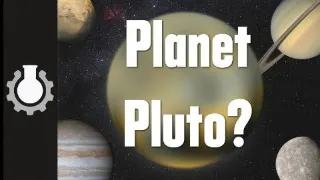
No, it is not a planet :)
On a dry lakebed in Nevada, a group of friends build the first scale model of the solar system with complete planetary orbits: a true illustration of…
Every second of your life you are under attack. Bacteria, viruses, spores and more living stuff wants to enter your body and use its resources for…
Time makes sense in small pieces. But when you look at huge stretches of time, it's almost impossible to wrap your head around things.
Where are the limits of human technology? And can we somehow avoid them? This is where quantum computers become very interesting.
How do we learn properly so we can be right all the time? How can we know that we know, when we don't know what we don't know?
There is a strange and mysterious world that surrounds us, a world largely hidden from our senses. The quest to explain the true nature of reality is…
Why do we sleep? We spend a third of our lives in slumber, but science has yet to determine exactly why we have do it. Here’s a look at how sleep…
Our bodies are pretty incredible, here's why!
What will humanity look like in 1000 years? Watch as we cover some cutting-edge innovations happening today. Thanks to the National Geographic…
We are so used to some things that we stopped wondering about them. Like light. What is light? Some kind of wavy thing, right? Kind of.
When you mix red and green, what do you get? White light is all of the colors, right? So, how do computer screens show you every wavelength of light?…